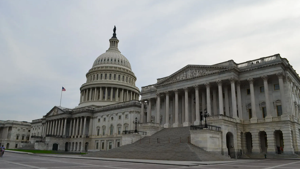
WATCH: Longest-ever government shutdown ends after 43 days
The U.S. House of Representatives voted to reopen and fund the federal government Wednesday night, ending the longest government shutdown in American history.
President Donald Trump almost immediately signed the bill into law, capping off 43 days that saw millions of federal workers either furloughed or working without pay, billions in GDP lost, SNAP payments halted, and mass flight delays across the country.
“For six long weeks, Americans have paid the price for a shutdown they neither caused nor deserved,” House Appropriations Committee Chairman Tom Cole, R-Okla., told lawmakers. “This is not how the greatest nation in the world should function. Today, that changes.”
Reps. Thomas Massie, R-Ky., and Greg Steube, R-Fla., were the only Republicans to vote against the legislation, which passed by a 222-209 vote.
The bill, which already passed the Senate on Tuesday, combines two pieces of legislation. One is a Continuing Resolution to keep the government funded until Jan. 30. This will buy lawmakers time to finish passing all 12 appropriations bills providing new funding for all agencies in fiscal year 2026, which began Oct. 1.
The other is a bipartisan minibus which knocks out three of those 12 appropriations bills. It authorizes full-year funds for Military Construction and Veterans Affairs; the Food and Drug Administration, Department of Agriculture, and Rural Development; and the Legislative Branch.
A last-minute provision that Senate Republicans tucked into the Legislative Branch portion, which would allow senators to sue the federal government if their phone records were subpoenaed, caused some uproar in the House.
But given the urgency of the shutdown situation, House Speaker Mike Johnson, R-La., said House Republicans will introduce and fast track standalone legislation to repeal the provision.
Reps. Jared Golden, D-Maine; Adam Gray, D-Calif.; Marie Gluesenkamp Perez, D-Wash.; Don Davis, D-N.C.; Henry Cuellar, D-Texas; and Tom Suozzi, D-N.Y.; were the only House Democrats who voted to reopen the government.
The shutdown began Oct. 1 after Senate Democrats filibustered Republicans’ original seven-week CR to keep the government open and funded. They continued to do so – 14 consecutive times – over demands that any funding deal also extend a pandemic-era expansion of the Obamacare Premium Tax Credit.
Eventually, eight senators in the Democratic Caucus finally provided the necessary votes for the bill to break the filibuster and move on to the House on Tuesday.
“The whole exercise was pointless, it was wrong, and it was cruel,” Johnson told lawmakers Wednesday night. “I think everyone needs to remember this one simple thing: from the very beginning of this whole ordeal, on the Republican side, we operated in good faith.”
Democrats disagreed, with Rep. Brad Schneider, D-Ill., chairman of the New Democrat Coalition, calling the funding bill “morally wrong.”
“The Republican bill does nothing to address the rising cost of healthcare,” Schneider said. “The government needs to be open. Nobody wins in a government shutdown…But we have to make sure that we’re fighting for Americans’ health care, we’re fighting to lower the cost of living for the American people.”






Chance Showers And Thunderstorms then Slight Chance Showers And Thunderstorms
Latest News Stories

Bill advances to prevent local governments from clearing homeless camps

Bonta’s anti-Exxon emails may have run afoul of CA corruption law: Claim

Expulsion votes for two members of Congress could happen next week, Luna says

NAACP sues xAI over air pollution near Memphis data center

Trump says he’s ready to nominate up to three Supreme Court justices
Military hostilities in Iran continue after Senate tanks War Powers Resolution

WATCH: Detransitioner battles to revive landmark malpractice and fraud lawsuit

Iran economic fallout is temporary, Hassett says

Illinois Quick Hits: NFIB says biz deduction will bring jobs, benefit to Illinois

Soaring costs and short supply shut millennials out of housing market
Vought testifies before lawmakers on Trump’s $2.1T budget request

SNAP eligibility changes spark debate on gap for impacted recipients