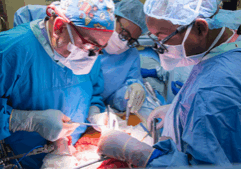
WATCH: UW-authored study on surgery times contradicts CMS basis for reimbursement cuts
New findings published in the Journal of the American College of Surgeons contradict the Centers for Medicare & Medicaid Services, or CMS, claim that surgery times have gotten shorter.
CMS has used the claims to justify a planned cut in reimbursement rates to surgeons.
Lead author Dr. Christopher Childers is an assistant professor of surgery at the University of Washington School of Medicine. He spoke with The Center Square about his findings.
“So, they released their proposed rule almost exactly a month ago now for 2026. And one of the things that’s been controversial is this kind of new policy that they’ve proposed called an efficiency adjustment,” Childers said of CMS’s proposed reduction in reimbursement for many physician services, including all surgical procedures by 2.5% starting in 2026.
According to Childers, despite advances in surgical techniques, operating times have stagnated or grown longer as surgeons care for more difficult patients.
“The argument that CMS was making in this proposed rule was that we’re getting more efficient. So, I’m doing surgery faster today than I [did] five years ago,” he explained. “That was their argument for why we should decrease the dollar value assigned to surgical procedures. Speaking for myself and other surgeons that I interact with, we don’t feel that’s the case. Things do not feel more efficient than they were five years ago.”
The study used nationwide surgical data from 1.7 million operations to evaluate the length of procedures.
“The American College of Surgeons has a database that they’ve been keeping for, I think, over 20 years now for surgical patients from around the country,” Childers said. “And they collect that data, and it’s primarily used for quality improvement efforts. You’re trying to figure out how we can reduce surgical site infections, how we can reduce length of stay, and just overall improve the care for patients.”
A news release from UW Medicine explained the data looked at operating times for 11 surgical specialties for standard procedures such as appendectomies, hernia repairs and hysterectomies.
“We did not see any evidence that things are getting faster. In fact, we actually saw a little bit of the opposite,” Childers noted. “We saw things are taking longer now than they were five years ago, because we are seeing more complicated, more sick patients. Patients are older. Patients have larger BMIs. They’re heavier than they were five years ago. They have more comorbidities. They’re more likely to have complications, so they’re staying in the hospital longer. And so, we’re not any more efficient. In fact, it might be the opposite.”
Childers – who is a cancer surgeon specializing in liver, pancreas and biliary procedures – said overall operation times have gone up by about 3%.
The proposed CMS changes will not, he says, save the government any money.
“Not in any way, shape, or form. If it did, I think that would be a very different discussion,” Childers said. “What it does is it just basically reduces the dollar values that are going to this very long list of things like surgery that are obviously of interest to me. What it does is it just reallocates that money to other services. And so, there’s no net savings from this.”
According to Childers, CMS’s stated goal has been to increase pay for primary care physicians because there is a major shortage of providers, especially in rural areas.
“The goal of this effort is a noble one in the sense that they feel that this country would benefit from having more primary care providers and that we should increase payment to primary care providers,” he said. “And even if you are able to increase primary care doctor salaries, there have been studies that have shown that doesn’t actually increase our ability to recruit individuals in primary care fields.”
Childers said many medical students are interested in other things, like surgery, radiology, or other medical specialty disciplines.
“I think they need to start with how do we recruit, and is salary even a component of that? I think we’re going to have a huge problem with people retiring early and going into different fields because the rat race just can’t continue,” he predicted. “You can’t continue to just get squeezed every single year, year over year, expecting that your productivity is going to go up.”






Mostly Sunny
Latest News Stories

Meeting Summary and Briefs: Public Works & Transportation Committee for December 2, 2025

Land Use & Development Committee forwards Women’s Residential Recovery Center

District 114 Ranks High in Will County for Math and Reading Growth

Will County Board Members Question Fairness of New Transit Tax Structure

P&Z Commission Advances Plan for Construction Debris Fill Operation on Brandon Road
Regional Transit Agencies Tout New State Funding, Prepare for Shift to ‘NITA’

Manhattan School District 114 Board Approves 2025 Tax Levy; Plans Abatement to Maintain Tax Rate

Meeting Summary and Briefs: Village of Manhattan Board of Trustees for December 2, 2025

New Lenox Used Car Dealership Approved by Land Use & Development Committee

Land Use Committee: Monee Solar Projects Granted Extensions; Battery Storage Plans Dropped

P&Z Commission: New Women’s Recovery Center Proposed for Patterson Road Receives Support
Ogalla Blasts New State Solar Legislation