S&P keeps U.S. outlook stable, but says federal finances won’t improve
A top-credit rating agency decided to keep its outlook for U.S. credit stable, but said the federal government’s financial position “won’t meaningfully improve” in the coming years.
S&P Global Ratings said spending is expected to outpace revenue, with Congress continuing a multi-decade practice of deficit spending despite warnings from within the government that the U.S. remains on an unsustainable fiscal path.
Congress is expected to continue with annual deficits, S&P noted.
“We don’t expect the deficit to decline to the Treasury’s stated goal of a 3% deficit over time,” analysts wrote. “To date, in our view, broad, bipartisan support on proactive measures to meaningfully lower high fiscal deficits and curtail the rise in government debt remains elusive, and this affects creditworthiness.”
Late Monday, S&P Global Ratings affirmed its ‘AA+’ long-term and ‘A-1+’ short-term ratings on the U.S. In May, the U.S. federal government lost its final ‘AAA’ rating after Moody’s knocked down the U.S. credit rating to AA1, projecting Congress won’t be able to reduce the nation’s growing debt. Moody’s was the last credit-rating agency to keep the U.S. at a top AAA rating. Fitch Ratings downgraded the U.S. in 2023 and S&P Global Ratings did so 2011.
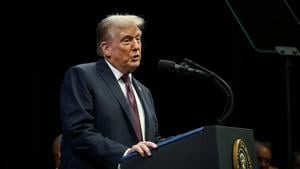
Republicans control all the levers of the federal government, holding narrow majorities in the House and Senate. For decades, the party has called for reducing federal spending, but has struggled to do so in the six months since President Donald Trump returned to the White House.
Trump said his Department of Government Efficiency would be the government cost-cutting equivalent of the “Manhattan Project.” Trump’s DOGE initially aimed to cut $2 trillion from the federal budget. Former DOGE boss Elon Musk later cut that estimate in half. At a Cabinet meeting in April, Musk said the group was on pace to cut $150 billion from the federal budget.
Congress passed a massive tax cut and spending bill earlier this year, expected to add $4.1 trillion to the national debt by 2034, mostly from the permanent extension of key tax provisions in the 2017 Tax Cuts and Jobs Act.
Trump’s tariff revenue will help offset some of the costs, S&P Global said.
“Amid the rise in effective tariff rates, we expect meaningful tariff revenue. At this time, it appears that meaningful tariff revenue has the potential to offset the deficit-raising aspects of the recent budget legislation,” analysts for S&P Global wrote. “We do not think that legislation, in itself, will reduce the deficit. It contains some significant spending cuts, namely on Medicaid, but also raises spending elsewhere, notably for defense and border security.”
Congress has run a deficit every year since 2001.






Slight Chance Showers And Thunderstorms then Chance Showers And Thunderstorms
Latest News Stories

Illinois quick hits: New Illinois Supreme Court justice installed

High schools throughout California stage walkouts over ICE
Pritzker celebrates expansion of French cheese maker in GOP leader’s district

WATCH: WA GOP lawmaker asking Trump administration to investigate fraud allegations

IL Accountability Commission chair: “People need to be prosecuted”
Graham blocks govt. funding vote over policy demands as deadline looms

Trump sues the IRS for $10 billion

Walz, Ellison to appear before House Oversight Committee

BREAKING: Don Lemon arrested for involvement in church attack

Lawmaker calls Pretti shooting an injustice, points to NRA statement as validation

DOJ to release more than 3 million Epstein documents Friday

WATCH: Commission meets as Chicago mayor seeks to prosecute ICE; SNAP changes Sunday