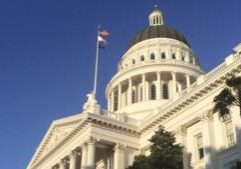
WATCH: CA Democrats pass congressional redistricting plan
After a day of vigorous debates punctuated by occasional applause, both houses of the California Legislature Thursday passed the three bills making up the congressional redistricting plan.
Votes were along party lines, with the Democratic supermajorities passing the legislation.
The Election Rigging Response Act, which includes a constitutional amendment and a map Republicans strongly oppose, goes to Democratic Gov. Gavin Newsom, who’s expected to sign it quickly. Then it will go on the Nov. 4 ballot in a special election, where voters will ultimately decide whether to redraw districts into ones that Republicans say favor Democrats.
If passed by voters, the measure will undo some of the work of the California Citizens Redistricting Commission, which voters created when they passed the Voters FIRST Act in 2008 and the related Voters FIRST Act for Congress in 2010. The panel consists of Democrats, Republicans and independents.
Democrats have said their goal is to nullify Texas’ attempt to secure five more Republican seats in advance of the 2026 midterm election in a U.S. House with a razor-thin GOP majority. And Republican legislative leaders speaking to The Center Square agreed the California redistricting could cost five Republican seats, including those in the GOP strongholds in San Diego and Orange counties and along the California-Nevada border. The vulnerable congressmen are Republicans Kevin Kiley, Doug LaMalfa, Darrell Issa, Ken Calvert and David Valadao.
In the Assembly and Senate, Democrats accused Republican President Donald Trump of an authoritarian power grab.
Republicans in both chambers said Democrats were pulling a power grab of their own with a map drawn behind closed doors and revealed in a rushed process.
But Assembly Speaker Robert Rivas, D-Hollister, called the congressional redistricting proposal “a proud moment” in the chamber’s history.
“We will not let our political system be hijacked by authoritarianism,” Rivas said, speaking from the floor during the session led by a fellow Democrat, Speaker Pro Tem Josh Lowenthal.
Also from the floor, Assemblymember Jesse Gabriel, D-San Fernando Valley, said Trump understands his policies are unpopular and will cost him the House in 2026.
To keep the House, Trump is trying to change the rules “in the most undemocratic fashion,” Gabriel said.
He said Democrats were acting democratically by presenting the congressional redistricting plan to voters on the Nov. 4 ballot. He said ultimately it’s not Trump or Newsom who will decide the issue.
“Let the people vote,” Gabriel said.
But Assemblymember Daniel Tangipa, a Republican representing Fresno and other nearby counties, criticized Democrats for replacing the work of the independent Citizens Recommissioning Commission, which had dozens of hearings, by a rushed process. Tangipa, who sits on the chamber’s Elections Committee, said Republicans were told by Democrats to accept their congressional redistricting plan, presented at the 11th hour, on faith.
“But democracy does not run on faith,” Tangipa said. “It runs on accountability.”
Another Republican, Senate Minority Leader James Gallagher, noted the redistricting will shrink California Republicans to a much smaller percentage of the congressional delegation.
Republicans would see their percentage of the state’s House delegation fall from 17% to approximately 8%.
Gallagher said that isn’t fighting fire with fire in response to Texas’ redistricting. “It seems like a sledgehammer.”
In the calmer setting of the Senate, Republicans echoed Gallagher and Tangipa’s concerns.
Democrats created the map without transparency, said Sen. Tony Strickland, R-Huntington Beach, adding, “I can’t think of anything more authoritarian than pre-determined elections.”
But Sen. Dave Cortese, D-San Jose, warned about the “dangers of unchecked power” and accused Trump of trying to disenfranchise voters by pressuring Texas for five more Republican seats, so that he can continue his extreme policies.
“That’s why this president and administration is a such a powerful threat to democracy,” Cortese said. “He’s no longer consolidating power among three branches. He’s disenfranchising and taking away the right to vote.”
Democratic legislators contended their new map reunites communities and keeps three-quarters of voters in their current congressional districts, but GOP lawmakers pointed to counties and cities being split throughout the state. The Center Square’s review of the map confirms that cities and counties would be divided.




Mostly Sunny
Latest News Stories
Expulsion votes for two members of Congress could happen next week, Luna says

NAACP sues xAI over air pollution near Memphis data center
Trump says he’s ready to nominate up to three Supreme Court justices
Military hostilities in Iran continue after Senate tanks War Powers Resolution

WATCH: Detransitioner battles to revive landmark malpractice and fraud lawsuit

Iran economic fallout is temporary, Hassett says

Illinois Quick Hits: NFIB says biz deduction will bring jobs, benefit to Illinois
Soaring costs and short supply shut millennials out of housing market

Vought testifies before lawmakers on Trump’s $2.1T budget request

SNAP eligibility changes spark debate on gap for impacted recipients

Trump puts spotlight on China, Iran’s top oil consumer
Lawmakers, auditors offer fraud prevention solutions