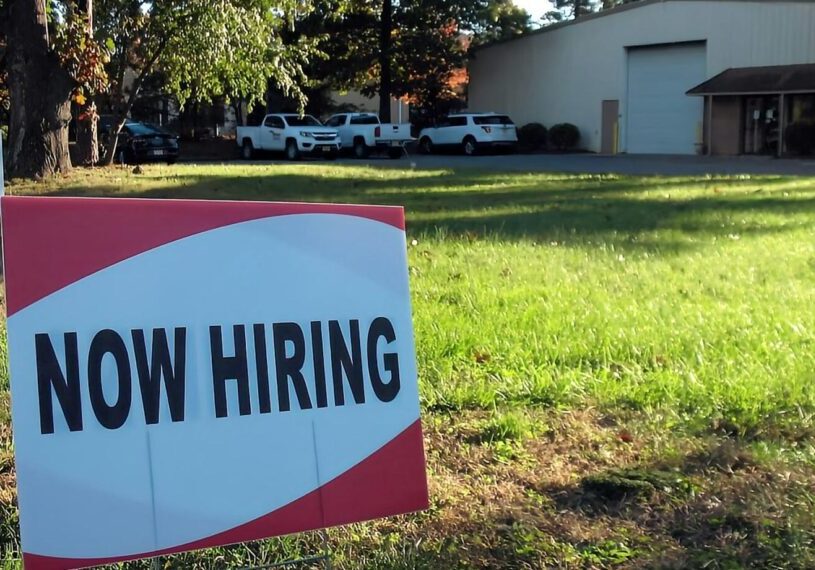
Everyday Economics: Jobs report takes center stage in week ahead
The economy finds itself in an uncomfortable position where growth is cooling while inflation pressures intensify. The Fed’s preferred inflation measure (PCE) shows core inflation at 2.9% year-over-year in July, up from 2.8% in June, continuing its drift away from the Fed’s 2% target that began in April. Meanwhile, economic momentum has clearly shifted. Job growth has averaged just 35,000 over the past three months when accounting for massive downward revisions, compared to 160,000-170,000 per month last year. Consumer demand is weakening with real personal consumption expenditures growth decelerating to 2.06% annually. This creates a challenging backdrop where the Fed faces pressure to support employment while inflation remains stubbornly above target.
The Main Event: August Jobs Report
Bottom Line Up Front: Expect another weak employment report that reinforces the case for a Fed ‘insurance’ rate cut, but don’t anticipate significant relief for borrowers beyond September’s likely quarter-point reduction.
The August jobs report arrives at a critical juncture for Federal Reserve policy. Initial unemployment claims have declined from recent highs, while the uptick in continuing claims has stalled. This mixed picture suggests labor market stabilization rather than further deterioration.
What the Claims Data Tells Us
The unemployment claims trajectory provides crucial insight into August’s likely employment outcome. Historical patterns show initial and continuing claims are reliable predictors of unemployment rate changes. The recent stabilization in initial claims and plateau in continuing claims points to an unemployment rate holding steady near July’s 4.2% level rather than rising further.
July’s Shocking Revisions Changed Everything
July’s employment report delivered a reality check that fundamentally altered our understanding of labor market health. Not only did employers add just 73,000 jobs in July, but May and June job gains were revised down by a combined 258,000. The three-month average plummeted to 35,000 jobs per month – the weakest pace since the pandemic recovery.
Critically, all net job growth in July came from education and health services. Strip out this sector, and total employment would have declined for the third consecutive month. This concentration reveals an economy where job creation has become dangerously narrow, with most industries either shedding workers or treading water.
August Expectations: Stability, Not Recovery
For August, expect modest job gains – just enough to prevent the unemployment rate from rising. Labor supply constraints mean lower employment gains are needed to maintain unemployment rate stability.
What This Means for Fed Policy
Markets are pricing in an 87% probability of a 25 basis point rate cut at the Fed’s September meeting. The August jobs report is unlikely to change this calculus unless it delivers a dramatic surprise in either direction. Fed governors Christopher Waller and Michelle Bowman have already signaled openness to rate cuts, acknowledging that labor market softening now poses greater risks than elevated inflation.
But here’s a crucial point: the labor market is stabilizing at a lower pace of employment gains and with more price pressures in the pipeline, one rate or two rate cuts might be all that’s needed to nudge this economy on a balanced growth path.
The Fed Reality Check
Inflation Remains Problematic: inflation remains above the Fed’s 2% target. Given the downshift in the economy’s productive capacity, the “One Big Beautiful Bill Act” could prove inflationary.
Implications for Borrowing Costs
With potentially fewer Fed rate cuts ahead than currently anticipated, borrowing costs won’t decline much further.
For Businesses: Expect modest relief on short-term borrowing costs following September’s likely rate cut, but don’t count on aggressive easing. Companies should focus on locking in favorable medium-term rates while they remain available.
For Consumers: Credit card interest rates and mortgage rates will see limited improvement from Fed cuts, as the 10-year Treasury yield reflects longer-term inflation expectations.
Borrowers should prepare for rates to remain “higher for longer” than markets currently anticipate.
The Path Forward
As the labor market stabilizes at a lower pace of employment gains, market participants will shift their focus again to longer-term inflation risks. We could see a replay of 2024 when Treasury yields and mortgage rates climbed even after the Fed began cutting rates.





Showers And Thunderstorms Likely
Latest News Stories

Illini Final Four trip expected to benefit University of Illinois, state of Indiana

Trump makes history at Supreme Court amid landmark birthright citizenship challenge

New Hampshire school district sued over transgender policies

Trump watches as high court hears challenge to his birthright citizenship order

Illinois Quick Hits: Prtizker says Trump order is unconstitutional

U of I pressed on costly abandoned development project, stance on DEI directives

Trump says Iran’s new leader wants ceasefire

‘Conversion therapy’ bans in IL, other states, in danger, after SCOTUS ruling
Lincoln-Way 210 Approves Student Registration and Meal Fee Increases for 2026-2027

County Board Approves Peotone Solar Farm Amid Debates Over Union Labor and Tornado Safety

Lincoln-Way West Offense Explodes in 12-2 Victory Over Revere
Illinois business leaders press lawmakers as child care costs face scrutiny