Banning AI instruction in college could stifle innovation, IL lawmaker says
(The Center Square) – Supporters of a new law prohibiting artificial intelligence being the sole instructor in community college say the move protects educational quality, but critics argue it will hold back innovation.
House Bill 1859 bars community colleges from replacing faculty with AI, though teachers may still use AI tools. Gov. J.B. Pritzker signed the measure Aug. 15.
“AI is a tool, not a teacher,” said state Sen. Mike Porfirio, D-Lyons Township. “Illinois must stay proactive when it comes to cutting-edge technology. This measure would protect the jobs of our teachers, and secure a legitimate education for our students.”
State Rep. Paul Jacobs, R-Pomona, opposed the bill, calling it too vague to work.
“It doesn’t really define AI. Anybody can put anything they want in there,” Jacobs told The Center Square. “It’s just so ambiguous … It’s going to stifle any kind of creativity.”
Jacobs warned that the speed of technological change will make Illinois’ restrictions unworkable.
“How do you pay for compliance? Are we going to have AI cops out there? You can’t enforce it. It’s just a very poorly written bill. Enforcement is ridiculous, you just can’t do it,” said Jacobs. “And as fast as AI is moving, this law will only make sure Illinois falls behind, which is pretty typical for our state when something promising comes along.”
Jacobs, who serves on the House Appropriations-Higher Education Committee, suggested AI could provide more affordable learning options for students if used carefully.
“Some classes can be taught with AI easily. Some people are able to learn that way. Others need the attention of the professor,” he said.
Jacobs, who also works in the medical field, pointed out that forms of AI are already being used in everyday professional settings, including health care.
“If you can define certain parts of AI to control, that might work. In my practice we already use lower-level AI in equipment that suggests diagnoses for glaucoma or tumors, but we mostly ignore it and do it ourselves,” Jacobs said. “AI will keep advancing, and while some might want to replace doctors with it, that’s something we have to guard against. The definition in this law just isn’t sufficient.”
A 2023 study by RAND Education and Labor found that roughly 25% of teachers already use AI tools in the classroom, and universities across the country, including Harvard, have experimented with AI teaching assistants.
Jacobs said Illinois should focus on defining how AI can be used instead of restricting it outright.
“They used to have programs where you taught yourself from a book, then tested when ready. I could see AI working the same way in college classes,” said Jacobs. “But professors and unions will fight it, no matter how beneficial it might be. It’s like the horse-and-buggy days when the car came along. Change is coming, but we still need to balance it with the personal touch in education.”






Mostly Cloudy then Chance Showers And Thunderstorms
Latest News Stories
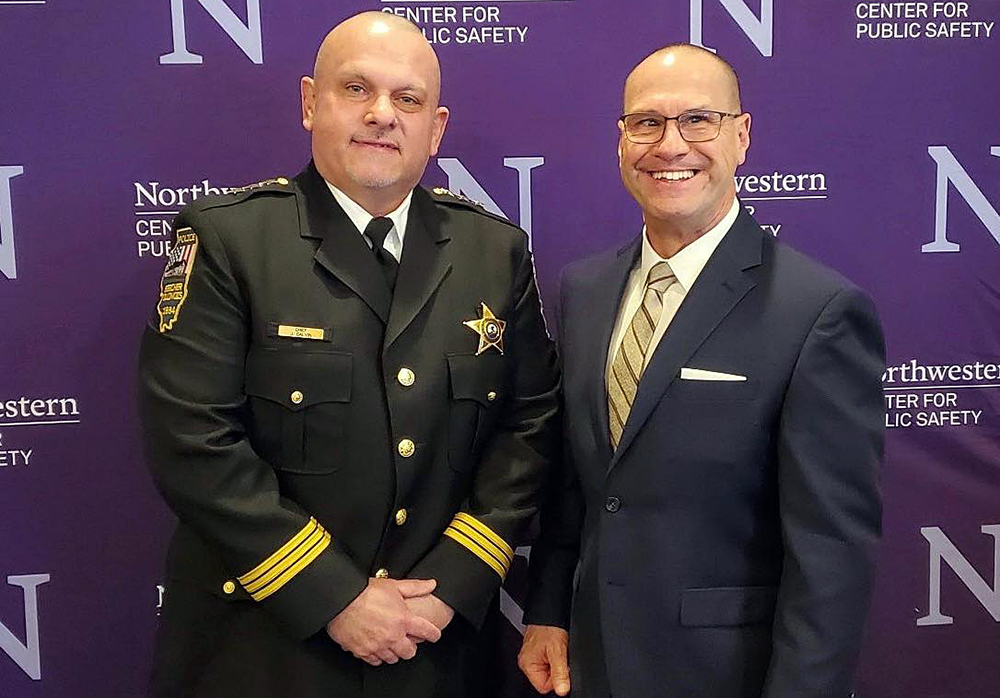
Corporal Ingram completes elite leadership training program
Meeting Summary and Briefs: Will County Board Executive Committee for January 8, 2026

Automatic Sprinklers Contain Industrial Fire in New Lenox

Blaze Destroys Building and Food Truck at Woldhuis Sunrise Nursery

Manhattan PD Celebrates Officer Podkul’s 20th Anniversary

Manhattan Woman Killed, Students Uninjured in Head-On School Bus Crash

Pritzker signs Clean Slate Act to automatically seal some criminal convictions

Freight Clusters Drive Push for Overhaul of Wilmington-Peotone Road; County Advances Broader 2050 Plan

Sunny Hill Administrator Defends Private Room Model Amidst Capacity Discussions
Manhattan School Board Votes to Adopt ‘Committee of the Whole’ Meeting Structure

Elite private colleges can’t cap off price-fixing collusion class action

Illinois Quick Hits: GOP gubernatorial forum set for Monday