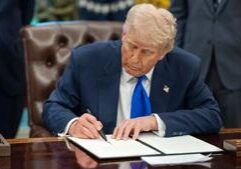
Trump’s tariffs ‘not survivable’ for some U.S. small businesses
The small businesses that challenged President Donald Trump’s sweeping tariffs told the U.S. Supreme Court that the import taxes are “not survivable” for some U.S. businesses.
“It is bedrock constitutional law – the very first clause of the section setting forth congressional powers – that Congress, not the President, has authority over all taxes on the American people,” attorneys for the small businesses wrote in a memo to the nation’s highest court.
The small businesses, represented by the Texas-based nonprofit Liberty Justice Center, urged the Supreme Court to take up the case.
“Because of the importance of the issues and the harms that Respondents are experiencing every day the unlawful tariffs are in place, Respondents acquiesce in the government’s petition for certiorari and its motion for expedited consideration,” lawyers for the businesses wrote.
The businesses say Trump has overstepped his authority under the 1977 International Emergency Economic Powers Act. Trump has used the law to hit every U.S. trading partner with tariffs of at least 10%. Rates vary by country with some as high as 50%. The issue: That 1977 law doesn’t mention tariffs.
Trump’s team says the phrase “regulate … importation” in the statute gives the president authority to use tariffs to address two national emergencies, a fentanyl epidemic and longstanding trade deficits.
“The government’s case rests entirely on the notion that the phrase ‘regulate … importation’ in IEEPA constitutes a boundless power to impose tariffs on the American people whenever the President wants, at whatever level he wants, for whatever countries and products he wants, and for as long as he wants, merely by declaring that longstanding U.S. trade deficits are a national ’emergency’ and an ‘unusual and extraordinary threat’ – assertions the government claims are effectively unreviewable,” the attorneys for the businesses wrote.
The Liberty Justice Center attorneys representing five small U.S. businesses called the government’s claims that taking away the president’s tariff authority will lead to an economic collapse “exaggerated.”
Last week, Treasury Secretary Scott Bessent wrote in a declaration to the Supreme Court that taking away the tariff authority “gravely undermines the president’s ability to conduct real-world diplomacy and his ability to protect the national security and economy of the United States.”
Bessent said the appeals court ruling has already hurt the administration’s efforts.
“The recent decision by the Federal Circuit is already adversely affecting ongoing negotiations,” Bessent said. “World leaders are questioning the president’s authority to impose tariffs, walking away from or delaying negotiations, and/or imposing a different calculus on their negotiating positions. The court’s ruling has taken away substantial negotiating leverage for the president to achieve the best trade deals for the American people.”
Two lower courts have already said the 1977 International Emergency Economic Powers Act doesn’t give the president unbounded tariff authority. In late August, the U.S. Court of Appeals for the Federal Circuit affirmed a previous lower court ruling, but said Trump’s tariffs could remain in place while the administration appeals to the U.S. Supreme Court. In the 7-4 decision, the majority said that tariff authority rests with Congress.
Trump’s administration has said the Supreme Court needs to resolve the issue.
Solicitor General D. John Sauer asked the Supreme Court to decide by Sept. 10 whether to take up the case. He also asked for “expedited consideration of the merits to the maximum extent feasible.” Sauer’s proposed schedule calls for briefs to be filed in the case by Oct. 20 and oral arguments set for the first week of November.
New tariffs raised $58.5 billion in revenue between January and June of this year before accounting for income and payroll tax offsets, according to an analysis of federal data from the Penn Wharton Budget Model.
Trump has said he wants to use tariffs to restore manufacturing jobs lost to lower-wage countries in decades past, shift the tax burden away from U.S. families and pay down the national debt.
A tariff is a tax on imported goods paid by the person or company that imports the goods. The importer can absorb the cost of the tariffs or try to pass the cost on to consumers through higher prices.
Economists, businesses and some public companies have warned that tariffs could raise prices on a wide range of consumer products.



Mostly Sunny
Latest News Stories

EXCLUSIVE: New House committee report highlights increasing terrorism threat in U.S.

Chicago aldermen pass revenue package, business groups express concern
DOJ posts thousands of Epstein documents to partially comply with law
DOJ lawsuit against Illinois draws support from election integrity advocates

Trump administration to dismantle federal climate center

Illinois quick hits: Federal funding for CTA still uncertain; fire risk for EVs
Feds sue IL for refusing to turn over full info on IL voters

WATCH: Detransitioner to providers: “Please just stop” gender surgeries on minors

Bears threaten move to Indiana after property tax break bill frustrations

Phoenix serial killer gets death penalty for six 2017 murders

Assembly leaders call for Dugan’s resignation, threaten impeachment
DOJ fails to fully comply with Friday deadline for Epstein files release