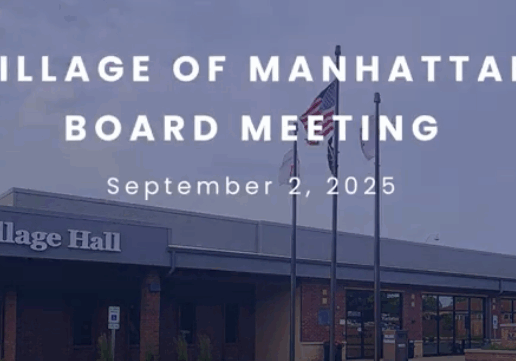
Manhattan Adopts 20-Year Comprehensive Plan to Guide Future Growth
Article Summary: The Village of Manhattan Board of Trustees has unanimously adopted a new Comprehensive Land Use Plan, a guiding document that will shape development, community investment, and growth for the next 20 years. The plan, which replaces a version from 2008, was created with extensive public input and aims to balance new growth with the preservation of the village’s small-town character.
Village of Manhattan Comprehensive Plan Key Points:
-
The plan serves as a 20-year roadmap for land use, development, and infrastructure.
-
It was developed over 16 months with public engagement through workshops, surveys, and open houses.
-
Key goals include expanding the commercial tax base, managing residential growth, improving transportation, and enhancing downtown.
MANHATTAN – The future of Manhattan now has a roadmap. The Village Board on Tuesday unanimously adopted a new Comprehensive Land Use Plan, a sweeping policy document designed to guide the community’s growth and development through 2045.
The plan, which replaces the village’s previous plan from 2008, is the result of a 16-month process involving significant public engagement. A representative from the consulting firm Houseal Lavigne, which drafted the document, presented the final version to the board.
“This comprehensive plan is a shared road map for the village of Manhattan,” the associate said. “Over the last 16 months, the plan has been massively shaped by public engagement… that you know, really resulted in a plan that is community-driven and that balances growth and the vision of Manhattan.”
The document will serve as a framework for regulatory tools like zoning and subdivision regulations and will influence decisions on everything from new housing developments to infrastructure investments. The plan was unanimously recommended for approval by the village’s Planning and Zoning Commission.
“Adoption tonight is the first step in implementation, moving this from a vision to action,” the Houseal Lavigne representative added.
The plan addresses several key themes that emerged from community feedback. A primary goal is to attract more commercial and light industrial development to diversify and strengthen the village’s tax base, which is currently heavily reliant on residential property taxes. Key areas identified for potential commercial growth include corridors along U.S. Route 52, South Cedar Road, and West Manhattan-Monee Road.
Another major focus is managing transportation, particularly the high volume of truck traffic through the downtown area. The plan supports a potential realignment of U.S. Route 52 to reroute heavy trucks, making downtown more pedestrian-friendly and preserving its historic charm.
Housing was also a central topic, with the plan calling for a balanced approach that includes more housing diversity, such as options for seniors, alongside traditional single-family homes. The plan promotes infill development—building on vacant land within existing village limits—to make efficient use of current infrastructure before expanding outward. Mayor Mike Adrieansen and the Board of Trustees approved the ordinance without further discussion, formalizing the document as the village’s official guide for the next two decades.
Showers And Thunderstorms Likely
Latest News Stories

Your Ultimate Guide to the 2025 Frankfort Fall Fest: Everything to Know for the Nationally-Ranked Event

HHS, Department of Education announce nutrition reforms
White House appoints interim CDC director; standoff continues with former director

WATCH: Pritzker claims Trump plans election interference with troop deployment

Plaintiffs take Cook County gun ban challenge to SCOTUS

Illinois quick hits: $1.57B return on investments; solar-powered manufacturer cuts ribbon
Report: Illinois U.S. Rep faces minimal penalty after disclosure violations

18 were injured, 2 killed in Minneapolis shooting

Trump HHS tells states to remove gender ideology from sex ed or lose PREP funding

Americans could face ‘sticker shock’ as once-small tax exemption ends
‘Pro-taxpayer’ law requires operators to clean up abandoned Illinois oil wells

Watch: Cook County gun ban plaintiffs petition SCOTUS; Pritzker hasn’t heard from White House