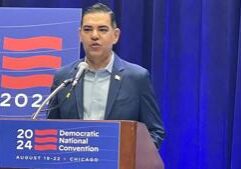
Democrats reject idea of constitutional amendment mandating balanced budgets
In light of the nation’s $38 trillion national debt, U.S. House lawmakers met Wednesday to discuss ways to structure a constitutional amendment mandating that Congress pass deficit-neutral budgets.
The House Judiciary subcommittee, however, produced no concrete plan and lawmakers mainly engaged in partisan blame games, even as multiple witnesses there to testify outlined possible solutions.
The U.S. has spent more money than it takes in for decades, resulting in skyrocketing deficits each year. In fiscal year 2025, the federal deficit – the gap between spending and revenue – amounted to roughly $1.8 trillion, the Congressional Budget Office estimated.
“The debt ceiling is a joke…a political football,” David Walker, chair of the Federal Fiscal Sustainability Foundation, told lawmakers. “The only thing that can bind current and future congresses and presidents is a constitutional amendment.”
Republicans, who mostly support such an amendment, say the debt and deficit problem is caused by excessive spending, and that the solution is enforced spending restraint.
A constitutional requirement that federal outlays not surpass revenue would apply to the whole of government spending – including automatically-renewed mandatory spending on entitlement programs – not just what lawmakers spend in annual appropriations bills.
“Mandatory spending, including net interest, has increased from about $1.6 trillion in Fiscal 2002 to a projected $5.1 trillion for Fiscal 2026,” Walker points out in his pre-prepared remarks. “In addition, federal deficits have increased from $158 billion to a projected $1.8 trillion during the same period even though the United States is not currently engaged in any major armed conflicts as was the case in 2002.”
Most Democrats, however, argue that the problem is driven by revenue-reducing policies like tax cuts, and that the solution is more revenue through increasing taxes rather than less spending.
Many highlighted how balancing the federal budget would require overhauling nearly all entitlement programs.
“This means you’re going to have to cut Social Security, Medicare, food assistance, and other programs that regular people rely on,” U.S. Rep. Rebecca Belint, D-Vt., said.
Minority witness Brendan Duke from the Center on Budget and Policy Priorities added that a deficit-neutral budget would exacerbate and prolong recessions.
“Revenue is the solution here, we should just have smarter taxes,” Duke said.
Walker said the problem requires addressing both spending and revenue levels, recommending lawmakers pursue a 3-1 GDP ratio — three parts projected spending reduction to one part revenue increase.
But the main problem with implementing a balanced budget amendment that actually works is how to enforce it while also allowing exceptions for emergencies.
Laws to enforce fiscal responsibility already do exist, such as PAYGO, which requires Congress to offset increases in mandatory spending by deficit reduction measures, triggering automatic spending cuts in other areas if lawmakers fail to comply.
Yet lawmakers nearly always take advantage of “emergency” exceptions to bypass PAYGO and other similar laws, allowing Congress to authorize $15 trillion in deficit spending since 1991, The Center Square reported.
“This whole place is unserious about balancing the budget, and if you give them any exemption, they’ll use it,” U.S. Rep. Thomas Massie, R-Ky., a well-known fiscal hawk, said.
Chairman Chip Roy, R-Texas, agreed that both sides are responsible for the current fiscal crisis.
“We are constitutionally, as members of Congress, hardwired unfortunately to want to effectively buy people’s votes with a never-ending array of spending programs – whether they are meritorious or not,” Roy said. “We have got to do something to stop mortgaging our children’s future.”






Partly Sunny
Latest News Stories

Data shows more violent retail thefts, lost sales tax revenue.

Data shows more violent retail thefts, lost sales tax revenue.
Arizona GOP considers suing to redraw congressional map
Arizona GOP considers suing to redraw congressional map
Arizona GOP considers suing to redraw congressional map

Illinois Quick Hits: Congressman’s aide indicted on fraud allegations

JJC Board Meeting Halted by Lack of Quorum; New Student Trustee Sworn In

Jackson Township Outlines Spring Community Outreach, Prepares for Route 66 Centennial

Johnson, municipal leaders statewide clash with Pritzker over local funding cuts

Johnson, municipal leaders statewide clash with Pritzker over local funding cuts

Pettit’s Home Run, Late Rally Propel Lincoln-Way West Baseball Past Andrew 5-2
Illinois bill would force employers to pay employees regular wages for jury duty