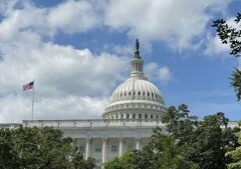
Congressional Conflicts: Curb on lawmakers’ stock trades draws fire for being weak
A limited ban on stock trading by Congress might get a vote next year after a 2012 law did not do enough to stem the practice that critics say is legal insider trading.The Center Square has been investigating the trades of lawmakers on key committees, finding trades that raise questions about the actions and timing.Since 2022, members of Congress have introduced measures to ban lawmakers from trading stocks altogether. Both last year and this July, the Senate Homeland and Governmental Affairs Committee advanced a stock-ban bill. Neither chamber has scheduled a vote on legislation despite overwhelming public support for a stock ban. According to Politico, House Majority Leader Steve Scalise, a Louisiana Republican, said he expects by early next year to vote on a bill that would permit lawmakers to keep stocks they own but bar them from buying new stocks. They would be required to provide seven days of notice before selling their current stocks.U.S. Rep. Anna Paulina Luna, a Florida Republican, filed what is known as a discharge petition to force House leadership to vote on a bill that would prohibit members of Congress, spouses and dependent children from trading stocks. As of Dec. 22, the petition has 74 signatories, far short of the 218 required.A statute passed more than a decade ago that was supposed to address the issue of Congressional stock trading has come under fire for being too lax as lawmakers continue to trade before key announcements, investigations by The Center Square found.
Tylenol tradesIn the last half year alone, three lawmakers each dumped stock in Kenvue Inc., the Summit, New Jersey-based maker of acetaminophen, the primary active ingredient in Tylenol, ahead of a government announcement questioning whether the use of the drug by pregnant women is linked to autism.
They did so despite recommendations from most financial analysts that investors buy or hold their shares. Since the government’s announcement, Kenvue’s stock has tumbled from roughly $21 a share this summer to less than $17 a share as of Dec. 22, a 19% decrease.
U.S. Sen. Sheldon Whitehouse of Rhode Island and U.S. Rep. Ro Khanna of California, both Democrats, reported that their wives sold $1,001 to $15,000 of the company’s stock in late August.That was less than a month before Secretary of Health and Human Services Robert F. Kennedy, Jr., said the federal government would slap a label on Tylenol tablets warning pregnant mothers that taking the popular painkiller could cause their unborn children to develop autism. The overwhelming consensus among scientists and medical researchers is there is no causal link between using Tylenol and developing autism.
A Whitehouse spokeswoman, Meaghan McCabe, did not return two emails seeking comment, while a spokeswoman, Sarah Drory, for Khanna issued a statement.
“Rep. Khanna doesn’t trade stocks, has pushed for years for a ban on trading and for the TRUST in Congress Act requiring independently managed trusts, and his voting record shows he is bold and principled in standing up for his values,” Drory said.
U.S. Rep. Scott Franklin, a Florida Republican, reported that through a joint account with his wife, he sold $1,001 to $15,000 of stock in Kenvue on June 16. He dumped the stock while serving as the vice chairman of a House Appropriations subcommittee that oversees the Food and Drug Administration’s budget, the federal agency that regulates Tylenol.
A Franklin spokeswoman, Melissa Tarte, did not return an email for comment. Disclosures delayed
In the last 12 months, three lawmakers blew past multiple deadlines to report their stock trades. U.S. Sen. Markwayne Mullin, an Oklahoma Republican and one of Congress’s richest members, filed what are known as periodic transaction reports beyond the 30-to-45-day deadline three times. Two House Republicans, Neal Dunn of Florida and David Taylor of Ohio, filed two reports past the deadline.
Mullin’s office did not return a phone call for comment, while those for Dunn and Taylor did not return emails.
Until 2012, members of Congress were required to disclose their stock trades once a year. The Stock Act requires members of all three branches – the legislative, judicial, and executive – of the federal government and their families and staff to report their sale or purchase of stock, bonds, and commodities within 30 to 45 days. If they miss the deadline, they are to be fined under a sliding scale that starts at $200 per tardy report.
On final passage in early 2012, the legislation sailed through both houses of Congress with only a handful of dissenters. “Send me a bill that bans insider trading by members of Congress, and I will sign it tomorrow,” President Barack Obama said at the State of the Union Address that year, a comment that prompted lawmakers to stand and applaud for 13 seconds.
Obama did just that in April 2012. For years, the law enjoyed public support with no serious attempts to amend or replace it.Craig Holman of Public Citizen, a lobbyist who helped write the Stock Act, said in an interview that he conducted research on the law’s effects. He found that the share of lawmakers who traded stocks decreased by more than one-quarter.“They just didn’t want to deal with the hassle of reporting the trades and getting bad publicity from them,” Holman said in an interview this summer.
By 2020, the Stock Act drew fire for failing to do what Obama said it did: prohibit U.S. officials from using insider information to profit on Wall Street. Then Sen. Richard Burr, a North Carolina Republican, reported selling $628,000 to $1.72 million of his holdings in stocks in mid-February 2020 after he received closed-doors briefings about the emerging coronavirus pandemic.
Burr was chairman of the Senate Intelligence Committee and a member of the Senate Committee on Health, Education, Labor, and Pensions. He said he obtained information about the pandemic from CNBC and other public sources. The FBI seized Burr’s cellphone, but the Justice Department announced in January 2021 that it had closed its criminal probe into his stock sales.



Showers And Thunderstorms Likely
Latest News Stories
Legislature takes more measures against firms opposing redomiciling in Texas

Mistrial declared in federal Palisades Fire arson case

Attorney: Supreme Court leaves path for property owners
Ex-cops blast Chicago mayor’s new agency

Illinois Quick Hits: Chicago reports increased visitor spending

Federalist Society panel takes on third-party lawsuit financing
Illinois to see 4 new consumer protection laws enacted

Illinois SNAP error rate rises; Pritzker blames Trump

Chicago video gambling hearing abruptly ends in debate, disarray

Illinois Quick Hits: Court rules against parents in East St. Louis busing case

DHS secretary blasts Illinois correctional centers

Chicago’s potential ‘teen takeover’ solutions cost taxpayers