Supreme Court could redefine 14th Amendment application
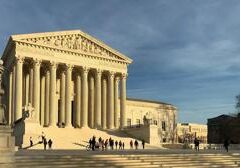
The U.S. Supreme Court will decide a case in 2026 challenging President Donald Trump’s authority to end birthright citizenship.
Trump v. Barbara challenges Trump’s executive order that denies birthright citizenship to children born after Feb. 19, 2025, whose parents are either illegally present in or temporary residents of the United States.
The concept of birthright citizenship rests on a Supreme Court interpretation of the 14th Amendment to include children born in the United States to foreign parents. The 14th Amendment reads: “All persons born or naturalized in the United States, and subject to the jurisdiction thereof, are citizens of the United States and of the State wherein they reside.”
Legal experts said the justices’ interpretations of “subject to the jurisdiction thereof” will likely be the deciding factor in this case’s outcome.
Michael Ramsey, a law professor at the University of San Diego, said the 14th Amendment gave citizenship to children born in the United States whether their parents were in the country legally or illegally. He said jurisdiction refers to an individual who is under the lawmaking authority of a certain nation.
“You are a citizen if you or your parents are under the authority” Ramsey said, “of the United States at the time you are born.”
He said individuals belonging to Native American tribes would not be included in the 14th Amendment’s citizenship definition because they operated under separate legal jurisdictions.
Ilan Wurman, a law professor at the University of Minnesota, pointed out that children of ambassadors living in foreign countries are offered citizenship under the United States. He argued this is because the roots of American law come from English common law.
Wurman said the status of a parent under the protection of the nation is a necessary condition to citizenship.
“Parental status is what matters and whether they are under the protection and therefore within the allegiance of the sovereign,” Wurman said.
Wurman argued that English common law established protection under a sovereign as a necessary condition to citizenship. Therefore, without protection, citizenship can be rejected.
“Birthright subjectship only applied if your parents were under the protection of the sovereign, and if your parents had come unlawfully, without invitation, without permission, without safe conduct, they would not have been under the protection of the sovereign,” Wurman said.
Ramsey argued that even when people are unlawfully in the United States, they are subject to the country’s laws.
“The reason that [diplomats] are outside of jurisdiction is because, again, as a general matter, diplomats are not subject to the lawmaking and law execution authority of the United States, because they have sovereign immunity, or diplomatic immunity under international law,” Ramsey said.
Wurman said people who enter the country illegally do not have access to the courts, which marks a clear distinction between those in combat situations.
“It’s true that there’s no body of international law that applies to people who come here illegally, who are not enemy aliens, who are not, you know, prisoners of war,” Wurman said.
The Supreme Court is expected to hear oral arguments for Trump v. Barbara in early 2026. A date has yet to be set for the case to be heard.




Chance Showers And Thunderstorms
Latest News Stories
School Board Approves ‘Board Book Premier’ for Paperless Meetings
Lincoln-Way 210 Prepares for “Retirement Wave” with Focus on Recruitment

District 114 to Overhaul Policy Updates with New ‘Press Plus’ Service
Lincoln-Way Board Weighs Community Solar Program Promising $155,000 in Annual Savings
Will County Reverses Zoning on Peotone Farmland to Facilitate 10-Acre Sale

Meeting Summary and Briefs: Joliet Junior College Board of Trustees for September 10, 2025
Manhattan Park Board Hires New Architect for Round Barn Buildout, Secures Annexation for Future Banquet Hall
Lincoln-Way 210 Board Approves $172.7 Million Budget with Planned Deficit for Bus Purchases
Manhattan School District 114 Approves $41.5 Million Budget for FY26
Manhattan Fire District Advances New Station with $8.75M Bond Hearing, Approves Contracts with $194,000 Savings

Will County to Pay Enbridge $82,000 to Relocate Pipeline Equipment for Exchange Street Improvements
Laraway Road Widening Project in New Lenox and Frankfort Gets Additional $468,000 for Redesign