Ad-Hoc Committee Retains Noise Ordinance Despite Enforcement Frustrations
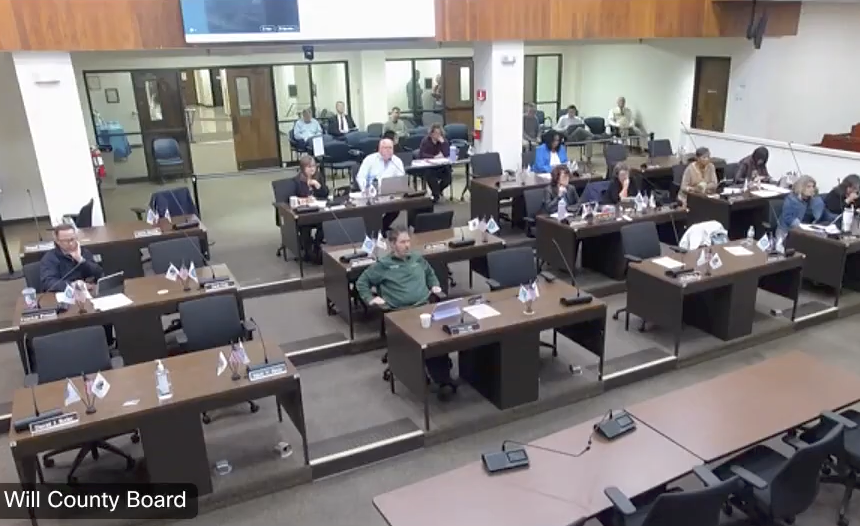
Will County Ad-Hoc Ordinance Review Committee Meeting | Jan. 13, 2026
Article Summary: The Ad-Hoc Ordinance Review Committee voted to retain the county’s public nuisance noise ordinance despite members describing it as “useless” without proper enforcement tools. The discussion highlighted a lack of calibrated decibel meters within the Sheriff’s Office necessary to prosecute violations.
Noise Ordinance Key Points:
-
Enforcement Gap: Board Member Sherry Newquist criticized the current situation, noting that without decibel meters, deputies cannot prove violations, making the ordinance difficult to enforce.
-
Equipment Needs: Assistant State’s Attorney Phil Mock explained that the courts require scientific standards for noise violations, necessitating calibrated decibel meters which the Sheriff’s Office currently does not maintain.
-
Future Funding: The committee discussed the need to lobby the Sheriff’s Office or allocate specific budget funds to purchase and maintain the necessary equipment.
Frustration over loud parties and music took center stage at the Will County Board Ad-Hoc Ordinance Review Committee meeting on Tuesday, January 13, 2026, as officials debated the effectiveness of the county’s noise regulations.
While reviewing Chapter 93 regarding Public Nuisances, Board Member Sherry Newquist expressed strong dissatisfaction with the current state of enforcement.
“I just want to say for the record that our noise ordinances are absolutely useless,” Newquist said. She recounted a situation where a resident could not get the Sheriff’s Department to issue a ticket for a neighbor holding concerts because the deputies lacked the means to measure the noise level. The resident eventually had to install his own meter to prove the violation.
Assistant State’s Attorney Phil Mock provided historical context, explaining that previous ordinances based on subjective hearing were ruled unenforceable by the courts. The current ordinance requires a scientific standard—specifically, a decibel reading—to withstand legal scrutiny.
“The problem is not our ordinance,” Mock said. “The problem is somebody needs to convince the Sheriff… to buy the new decibel meter and keep it accessible.”
Mock noted that while the department had meters in the past, they require periodic calibration to remain valid in court, a practice that has seemingly lapsed.
Committee members discussed the possibility of approaching the Sheriff regarding the budget for such equipment in the future. “I would say keep it on the books because it is a chronic problem,” Member Daniel Butler said.
The committee voted unanimously to move the Chapter 93 amendments to the Executive Committee, keeping the noise regulations in place.




Showers And Thunderstorms
Latest News Stories

Consensus for power supply solution still elusive
Digitization of aviation supply chain an opportunity to ascend out of 1950s

Zoning Cases in Crete and Manhattan Townships Postponed to December 16

Will County Commission Approves New Lenox Variances, Overriding Staff’s Denial Recommendation

‘Classic impasse’ for Chicago aldermen debating proposed taxes, spending cuts
Lincoln-Way 210 Board Approves Tentative 2025 Tax Levy with 4.57% Increase

Texas authorities arrest men for violent crimes after illegally entering as minors

WATCH: Gun ban cases and the Supreme Court; English and CDLs; Don Tracy eyes Senate

Illinois quick hits: Madigan disbarred; taxpayers subsidize medical debt relief
Will County Executive Committee to Hash Out Budget Cuts Following Levy Reduction
Meeting Summary and Briefs: Manhattan Township for September 9, 2025

Inflation-adjusted teacher salaries drop despite record spending on public education