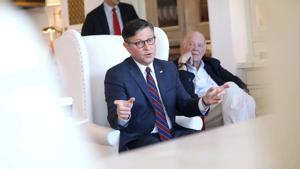
WATCH: Democratic legislators introduce anti-ICE legislation
A coalition of Democratic legislators announced several bills they’re introducing this year to target the activity of U.S. Immigration & Customs Enforcement in California.
“Across our country, we’re seeing federal overreach,” Assembly Speaker Robert Rivas, D-Salinas, said Thursday at the beginning of a press briefing announcing the legislation. “We are seeing an abuse of authority and a dangerous erosion of basic accountability. In California, we’re not going to look away, and we’re certainly not going to normalize what is occurring.”
Legislation introduced by Assemblymember Alex Lee, D-Milpitas, would eliminate state tax breaks from California companies that contract with the U.S. Department of Homeland Security.
The bill, which does not yet have a number assigned to it, aims to keep taxpayer money from going to businesses that aid ICE activity in the state.
“If you are a corporation that has contracts or business with ICE, and profits off the deportation machine, your California tax breaks will be canceled,” Lee told The Center Square in an exclusive interview on Thursday. “This is to push corporations to do the right thing. That will leverage them so they can stop doing business with, and supplying, aiding and abetting ICE.”
California gives $40 billion worth of tax breaks to companies across the state, Lee said. While the amount of money given in tax breaks to companies that do business with agencies like ICE is unclear, Lee hopes to target companies he said conduct business with those agencies. That includes Big Tech companies like Palantir, Lee said.
“There’ll be some, like CoreCivic and GEO Group, which are private detention companies and their whole business practice is pretty reliant on the detention facility process,” Lee said “So they might not come along absolutely.”
However, Lee said, only a small part of some companies’ business depend on have active contracts with federal law enforcement agencies like ICE.
“Depending on the company, it could be a lot of money that is riding on these businesses,” Lee told The Center Square. “It’s also one way to keep the public shame. Their employees, some of their board members, consumers, customers out there are really outraged at ICE right now, and they don’t like any association with ICE. You’re seeing a lot more backlash against those corporations.”
Several other anti-ICE bills announced on Thursday target employment by ICE or its parent agency, the U.S. Department of Homeland Security. A bill by Assemblymember Anamarie Ávila Farías, D-Concord, would disqualify ICE officers or officers from other out-of-state correctional agencies from getting jobs in California as peace officers or educational employees.
A similar bill from Assemblymember Isaac Bryan, D-Los Angeles, would keep a peace officer in the state from working for the Department of Homeland Security, even as a volunteer. He also introduced a bill that would allow families who receive CalWorks benefits to continue receiving those benefits if their child is apprehended by federal immigration authorities.
The efforts to keep current or former federal law enforcement officers who assist in immigration enforcement from pursuing jobs as peace officers later in their careers have implications for federal officers outside of ICE who assist in carrying out immigration enforcement, said one researcher and Coast Guard veteran.
“If my ultimate career goal is to be a peace officer in California, don’t join the Coast Guard,” Steve Smith, a public safety researcher at Pasadena-based Pacific Research Institute, told The Center Square on Thursday. “Now if I’m a border patrol officer and I’m not into enforcing the law, all I have to do is resign. But there’s no way to resign from the Coast Guard.”
The U.S. Coast Guard, U.S. Customs & Border Patrol and ICE are under the direction of the U.S. Department of Homeland Security. The U.S. Department of War oversees the Army, Navy, Marines, Air Force and Space Force.
While it might be hard to predict how some of these bills will impact taxpayers, if some of these laws pass, Smith said, California’s taxpayers and society as whole will pay the price.
“If you’re going to have a system by which you can’t enforce the law, I guess we’re going to have a cost for not assisting in the deportation of felons who have completed their sentences,” Smith told The Center Square. “So there’s certainly a societal cost, and there’s going to be a knock on taxpayer costs.”
The other bills target rental car companies from renting vehicles to officers involved in immigration enforcement, require increased transparency from hotel agreements with federal immigration enforcement agencies, require the California Attorney General to investigate a federal immigration officer-involved shooting and restrict ICE officers’ abilities to go to voting centers during an election.
The move to roll out legislation that targets ICE activities in California comes just days after Assemblymember Jesse Gabriel, D-Encino and chair of the Assembly Budget Committee, told The Center Square that he was introducing two new bills that would keep state resources from being used by federal law enforcement agencies, including ICE.
The flurry of legislation follows a contentious weekend in Minnesota, in which a nurse, 37-year-old Alex Pretti, was fatally shot in a federal officer-involved shooting during a protest in Minneapolis.
Other states have taken action in recent days, anticipating that ICE and other federal law enforcement agencies could carry out similar operations outside Minnesota. The state Senate in Washington passed legislation on Wednesday that would ban law enforcement agents from wearing masks. Similar actions are being considered in Virginia, Pittsburgh, Pennsylvania and Ohio, as well as Congress.
“The overriding theme on this is no one wants to see what’s happening in Minnesota,” Sen. Tony Strickland, R-Huntington Beach, told The Center Square on Thursday afternoon. “But it’s only happening in areas where we have sanctuary city and sanctuary state laws. I don’t think anybody would argue we want to get rid of sex offenders, drug dealers, et cetera, but because of these laws, they’re out on the street.”





Mostly Sunny
Latest News Stories

WATCH: Trump: Pritzker should ‘beg;’ Veto Session begins as Madigan reports to prison

Meeting Summary and Briefs: Will County Board Public Health & Safety Committee for October 2, 2025
Will County Shapes 2026 Federal Agenda, Prioritizing Health, Housing, and Workforce Funding

WATCH: Trump: Pritzker should beg for help with public safety in Chicago

L.A. congresswoman insists on health insurance tax credits
Newsom threatens university funding over Trump’s education deal

Former Los Angeles schools chief runs against city’s mayor

Illinois quick hits: WARN report layoffs total 1,689; Powerball winners in Rochelle and Colona

No ethics reform in sight as ex-speaker’s scheduled prison term begins
Trump losing ground on economy, poll finds

Major tech company to cut H-1B visas amid Trump pressure, fee
US, India to hold new round of trade talks, with focus on energy