California group opposes property tax hike, billionaires’ tax
Officials with the Howard Jarvis Taxpayers Association are concerned about efforts to raise property taxes on California’s homeowners, a representative of the organization told The Center Square this week.
The trepidation that the state’s homeowners might see property taxes go up stems from transfer-tax loopholes, the proposed billionaires’ tax and the state’s budget deficit, according to organization officials and a letter sent earlier this month by the group to its members.
The letter explained that California used to have a small 0.11% transfer tax on the transfer of ownership when property changed hands, which was kept from increasing by Proposition 13. A series of court decisions in the years after Prop. 13 passed in 1978 then allowed “charter cities” to institute their own transfer taxes that were much higher than the 0.11% limit imposed by Prop. 13, according to the letter from the well-known taxpayers organization.
“We have a situation in California where there’s not only a state budget deficit, but all the cities and counties are under pressure because of pension obligations and liability judgements,” said Susan Shelley, vice president of communications for the Howard Jarvis Taxpayers Association.
“They’re under tremendous budget pressure, and they’re all looking for tax increases,” Shelley told The Center Square. “So we’ve seen more and more of what we consider to be unconstitutional taxes being enacted anyway.”
The proposed billionaires’ tax, too, is causing concern at the taxpayers association.
The effort to pass the tax is sponsored by Service Employees International Union – Healthcare Workers West (SEIU-UHW). The proposal is to impose a one-time 5% tax on California residents whose wealth exceeds $1 billion, according to documents from the California Attorney General’s Office and previous reporting by The Center Square.
California Gov. Gavin Newsom has voiced his opposition to the measure, according to multiple news reports.
“This is an entirely new kind of tax,” Shelley told The Center Square. “This is not a tax on income. This is not a tax on sales. This is not a tax on capital gains. This is a tax on existing property.”
It’s no consolation that the tax only affects those with $1 billion or more in wealth, Shelley continued.
“Once they put this in place, where everyone has to tell the government everything they own and what its value is every year, then there’s a mechanism in place to tax retirement funds, home equity, possessions,” Shelley told The Center Square. “That’s never happened in America before, where people’s possessions would be taxed just because they own them. We are very concerned about that, and we believe it would totally come down to the middle class very quickly.”
Also at issue is the state’s projected $18 billion budget deficit, which the Legislative Analyst’s Office reported in November.
While Newsom released a budget proposal earlier this month that puts the state’s deficit at only $2.9 billion, the LAO said the multi-year deficits caused by the governor’s budget would prove to be alarming, as previously reported by The Center Square.
“We’re very concerned about the long-term effect of so much debt at the state level,” Shelley told The Center Square.
According to a database compiled by the Washington, D.C.-based Tax Foundation, California had an effective property tax rate of 0.70% of a home’s assessed value in 2023, the last year for which data was available.
The state with the highest property tax rate is Illinois, with a 1.83% property tax rate, according to the database.
New Jersey, Connecticut, Nebraska, Vermont, New Hampshire, Texas, Ohio, New York, Wisconsin, Iowa, Kansas, Pennsylvania, Michigan, Rhode Island, Minnesota, South Dakota, Massachusetts, North Dakota, Maine, Alaska, Maryland, Missouri, Oregon, Oklahoma, Georgia, Indiana, Virginia, Washington State, Florida and Kentucky all had at least marginally higher property tax rates than California, the Tax Foundation data show.
Lawmakers who sit on tax-related committees in the California State Legislature, as well as dozens of homeowners’ associations across the state, did not return calls to The Center Square or were unavailable to answer questions.



Showers And Thunderstorms Likely
Latest News Stories
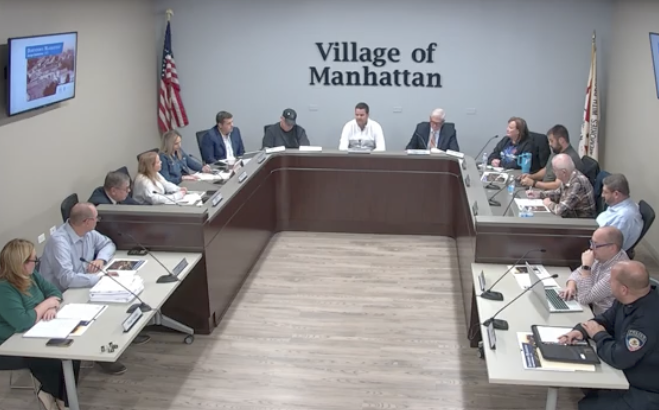
Manhattan Adopts Downtown Design Guidelines to Unify and Revitalize Village Center
Will County Committee Advances Phased Takeover of Central Will Dial-A-Ride Service
Manhattan Grapples with Route 52 Safety After Tragedy, Demands Action from IDOT
Manhattan Park District Ratifies Emergency Purchase of Bucket Truck for $36,500
Meeting Summary and Briefs: Will County Planning and Zoning Commission for October 21, 2025
Meeting Summary and Briefs: Will County Board Finance Committee for October 21, 2025
Meeting Summary and Briefs: Manhattan Fire Protection District for September 15, 2025
Future of Will County’s Cannabis Fund Debated Amid Budget Shortfall
Manhattan Fire District Earns Clean Audit, Hires Investment Manager
Meeting Summary and Briefs: Manhattan Village Board for October 21, 2025
Will County Health Department Pleads for $1 Million to Avert ‘Weakened Public Health System’
Manhattan Village Board Approves Water and Sewer Rate Hikes to Fund Future Infrastructure
Safety Upgrades Coming to Dangerous Route 50 and County Line Road Intersection
Manhattan Bans Retail Sale of Kratom, Citing Public Health and Addiction Risks