Will Land Use Committee Evaluates Multi-Million Dollar Buyout for Flooded Harris Drive Homes
Will County Land Use & Development Committee Meeting | March 5, 2026
Article Summary: The Will County Land Use and Development Committee is exploring a multi-million-dollar buyout program for several homes in an unincorporated Joliet subdivision that is plagued by chronic flooding and failing septic systems.
Harris Drive Flooding Key Points:
-
A near-final engineering study by Baxter & Woodman suggests that purchasing and demolishing eight to nine homes is the only viable long-term solution to the neighborhood’s drainage crisis.
-
Total costs for appraisals, legal fees, acquisitions, relocation stipends, and demolition are expected to exceed $3 million.
-
The neighborhood sits near the DuPage River and suffers from a combination of surface runoff and high groundwater levels that overwhelm 1970s-era septic systems.
-
Because the area does not meet income qualifications for Community Development Block Grant (CDBG) funds, the county is actively hunting for competitive grant matches to fund the buyouts.
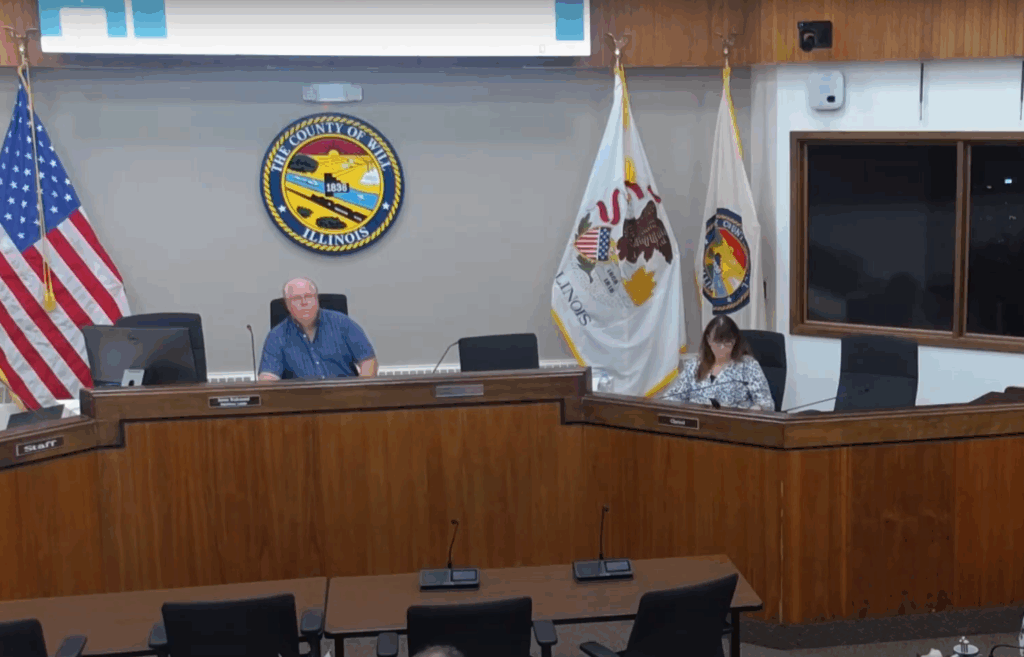
The Will County Land Use and Development Committee on Thursday, March 5, 2026, waded into a complex infrastructure crisis, reviewing a proposal to execute a multi-million-dollar buyout of heavily flooded homes on Harris Drive in unincorporated Joliet Township.
The discussion spilled over from the Public Health and Safety Committee meeting earlier in the day, where residents detailed how severe seasonal flooding and groundwater intrusion regularly disable their aging septic systems, leaving them unable to use their household plumbing for days or weeks at a time.
According to county Land Use staff, the county’s Stormwater Committee has been grappling with the Harris Drive flooding for over a year. The county recently hired engineering firm Baxter & Woodman to update a 15-year-old drainage analysis of the subdivision.
“What they’ve discovered is that because of the situation out there with the groundwater and the stormwater runoff, there’s probably about eight to nine homes that really just need to be purchased and the landowners need to be relocated,” a Land Use staff member explained to the committee. “Minor drainage improvements that the county could work to help get in place… are not going to be a big payback. They’re not going to help out the residents.”
Staff explained that simply putting in new ditches or grading the existing topography would not solve the core issue. Many of the homes, built around 1970, sit completely at grade—meaning their foundations are not elevated above the surrounding soil. When runoff flows from an adjacent uphill farm field, the water has nowhere to go but into the yards and homes, effectively drowning the septic leach fields.
Board members asked if the county could negotiate an intergovernmental agreement to hook the homes up to the City of Joliet’s municipal sewer and water systems. However, staff noted that because Harris Drive sits downhill from Joliet’s infrastructure, connecting the neighborhood would require the construction of an expensive lift station. Joliet officials previously indicated that such a project would also cost millions of dollars, require steep tap-on fees, and likely mandate annexation into the city.
With traditional engineering fixes ruled out, the county is looking at a massive real estate transaction.
“If you look at recent sales, each home is probably in the $250,000 to low $300,000 price [range],” staff noted. “You’ve got to have appraisals done, there’s engineering work, deeds have to be prepared, legal fees. Then you can’t just buy a home, you’ve got to help relocate the person… and then there’s demolition too.”
Because the neighborhood does not qualify as low-income, the county cannot tap into its standard Community Development Block Grant (CDBG) funds. Instead, the Stormwater Committee has identified roughly five competitive state and federal grants that could potentially fund the buyouts, though virtually all will require a substantial local funding match.
Staff cautioned that even if a grant is secured, the process mimics the county’s decade-long buyout efforts along the DuPage River and will require immense patience from residents.
“It’s not going to be immediate,” staff warned. “There’s no immediate fix because there’s not $3 million just available today to go out and take care of things like that.”




Showers And Thunderstorms Likely
Latest News Stories

Three years later, Inflation Reduction Act blamed for higher Medicare costs

Illinois quick hits: Prosecutors charge two more in Tren de Aragua case; Senate Energy and Public Utilities Committee meets today; Illinois Little League team loses in World Series

Report: Human Rights Campaign pressures transgender procedures on minors

Kankakee Bridge Project Out for Bid at $1.6 Million, Baker Road Bridge Nears Completion

Everyday Economics: Housing market and Fed policy in focus in the week ahead

Meeting Summary and Briefs: Manhattan Fire Protection District Board of Trustees for July 11, 2025
Executive Committee Considers $12,000 Strategic Planning Initiative with University of St. Francis

Businesses brace for new tax challenges amid global tariff focus

Illinois takes over health insurance marketplace in 2026 amid skepticism

WATCH: IL state reps challenge IEMA-OHS responses to local agencies

Judge expands restraining order against ‘Beto’ O’Rourke, adds ActBlue

District to Issue Up to $8.75M in Bonds for New Fire Station