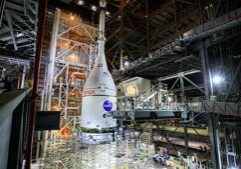
NASA plans to build $20 billion base on the Moon
NASA has abandoned its plans to build a lunar-orbiting space station and will instead use those resources to construct a $20 billion permanent base on the moon, scheduled for completion within seven years.
This major policy shift is outlined in NASA’s new roadmap, which describes a multi-phase approach to establishing a sustained human presence on the moon. The plan relies on international and commercial partnerships, advanced technologies and a $20 billion investment. NASA also aims to fulfill the ambitious space goals set by President Donald Trump.
“NASA is committed to achieving the near‑impossible once again, to return to the Moon before the end of President Trump’s term, build a Moon base, establish an enduring presence, and do the other things needed to ensure American leadership in space,” NASA Administrator Jared Isaacman said Tuesday.
As part of this shift, NASA will pause its Gateway project, which had aimed to build a small lunar-orbiting space station by 2027. Some of Gateway’s hardware will be repurposed for the new moon base initiative.
NASA’s plan will unfold in phases. The first phase focuses on repeatable missions deploying rovers, scientific instruments, and power generation equipment to the moon. The second phase introduces semi-habitable infrastructure and regular logistics in partnership with international collaborators. Heavier infrastructure to support a continuous human foothold will follow, marking the transition from periodic expeditions to a permanent base.
“The moon base will not appear overnight,” Isaacman said. “We will invest approximately $20 billion over the next seven years and build it through dozens of missions, working together with commercial and international partners.”
Isaacman noted that the International Space Station’s lifespan is limited.
“The transition to commercial stations must be thoughtful, deliberate, and structured to support long-term industry success,” he said.
Part of the new strategy involves building a nuclear power station on the moon. NASA and the U.S. Department of Energy plan to construct a nuclear reactor by 2030 to support future missions to Mars. The agencies say the fission surface power system will provide safe, efficient, and plentiful electrical power, capable of operating for years without refueling.
NASA will launch the Space Reactor‑1 Freedom, the first nuclear-powered interplanetary spacecraft, to Mars before the end of 2028. It will enable advanced nuclear-electric propulsion in deep space.
“Nuclear electric propulsion provides an extraordinary capability for efficient mass transport in deep space and enables high power missions beyond Jupiter where solar arrays are not effective,” according to the space agency.
Upon reaching Mars, SR-1 Freedom will deploy the Skyfall payload: Ingenuity-class helicopters designed to explore the Martian surface. The mission will also test flight-ready nuclear hardware, establish important regulatory and launch precedents, and bolster the industrial foundation for future fission power systems. By partnering with the U.S. Department of Energy, NASA aims to enable sustained exploration beyond the Moon, paving the way for eventual missions to Mars and the outer solar system.
The multi-stage Artemis program is expected to cost more than $100 billion. NASA’s acting inspector general told Congress in 2024 that the agency’s total Artemis campaign costs are projected to reach $93 billion for fiscal years 2012 to 2025.
The inspector general also projected that the SLS/Orion system and related ground launch infrastructure will cost at least $4.2 billion per launch for the first four Artemis missions. That does not include $42 billion in formulation and development costs spent over the past 12 years.






Showers And Thunderstorms Likely
Latest News Stories

Meeting Summary and Briefs: Village of Manhattan for October 7, 2025
Lincoln-Way to Purchase New Buses, Add Smaller Vehicles to Address Driver Shortage
Meeting Summary and Briefs: Jackson Township Board September 2025
Manhattan Seeks $250,000 State Grant for Safe Routes to School Program

Lincoln-Way Board Honors Students with Perfect ACT Scores, Music Educator of the Year
Manhattan 114 Reviews Fall Student Benchmark Data, Sees Strong Growth
Public Hearing for 41-Home Butternut Ridge South Subdivision Continued in Manhattan
Lincoln-Way Support Staff Union Rejects Tentative Contract Agreement

Highway Commissioner Reports on Equipment Updates and Millsdale Road Closure

Meeting Summary and Briefs: Will County Board Legislative Committee for October 7, 2025
Parents, Mayor Raise Concerns Over Special Education Services at Manhattan 114 Board Meeting
Manhattan Awards Over $1.3 Million in Bids for Major Water Main Upgrades
Will County Board Committee Passes Contentious ‘Live and Work Without Fear’ Resolution on 4-3 Vote
Will County Awards $10.4 Million Contract for Bell Road Widening in Homer Glen Area