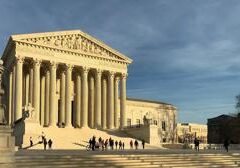
Supreme Court appears to favor Trump’s asylum border policy
The U.S. Supreme Court appeared in favor of the Trump administration’s policy to prevent immigrants making asylum claims from being processed if they are on the Mexico side of the U.S.-Mexico border.
The court heard arguments in Noem v. Al Otro Lado, a case challenging whether a former Trump administration “metering” policy – that prevented immigrants on the Mexico side of the U.S.-Mexico border from claiming asylum protections – is against U.S. immigration law.
The 1990 Immigration and Nationality Act allows an individual who “arrives in the United States” to apply for asylum status and be inspected by an immigration officer.
Several of the justices questioned at what point it can be determined that an immigrant “arrives in the United States.” Justice Amy Coney Barrett specifically drilled into what the definition of arrival means.
“What is the magic thing that we’re saying happens to make it so now someone arrives in the United States,” Barrett asked.
Kelsi Cockran, a lawyer representing Al Otro Lado, said the determination is made once an individual is “at the threshold” of a port of entry “about to step over.”
Justice Brett Kavanaugh appeared to criticize Cockran’s response. He called for a specific definition that the court could apply moving forward.
“It seems very artificial trying to figure out, ‘at the threshold,’” Kavanaugh said. “Threshold means government will stop you short of the threshold.”
Several other justices proposed various hypotheticals seeking to define the term “arrives.” Chief Justice John Roberts said someone standing in a long line at a concert venue cannot be considered as arriving.
“If you’re at the end of a long line, you’re not there, you haven’t arrived at the turnstile,” Roberts said.
Several justices argued the Trump administration was seeking to encourage illegal immigration by preventing individuals from crossing the southern border to apply for asylum. Justices Sonia Sotomayor and Ketanji Brown Jackson said appearing to encourage illegal immigration seemed at odds with the Trump administration’s agenda.
Jackson questioned whether an illegal immigrant would be privileged over someone seeking status at a port of entry like the U.S.-Mexico border.
“Why would his asylum request be discarded but someone who manages to enter the United States illegally and requests asylum gets their application entertained,” Jackson said.
Vivek Suri, a lawyer representing the Trump administration, argued the metering policy is designed to control the flow of individuals at ports of entry.
“Metering is not saying you can never enter the U.S. and the only option is to enter illegally,” Suri said. “The U.S. has greater responsibilities to those in the U.S. than those in Mexico.”
The Trump administration’s “metering policy” is not currently in effect because the border has been closed off to prevent entry. This led Jackson and Sotomayor to argue the policy should not remain in effect.
Suri said the administration would like to have the option to effectively administer this policy, without it being blocked in the courts if the border does open up eventually.
“This is a tool that [The Department of Homeland Security] would want in its toolbox,” Suri said. “This is an important tool that the government would want in its toolbox.”
“[It’s] necessary for ports to say ‘sorry, we’re at capacity, try again next time,’” Suri said.
The Supreme Court is expected to deliberate on its ruling and issue a decision by the end of its term in June.






Chance Showers And Thunderstorms then Showers And Thunderstorms
Latest News Stories
193 youth in care of Illinois’ child welfare agency missing in 2025

Hemp industry advocate promises to work with Pritzker, lawmakers

Bill would make health care sharing ministries tax deductible

HHS terminates Biden-era rule that rewarded doctors for ‘anti-racism’ plans

Average cost of family insurance nears $27,000 a year
U.S. House to vote on releasing the Epstein files

Vermont looks to encourage legal immigration pathways

Will County Committee Approves Rezoning, Denies Landfill Permit for Former Joliet Beach Club Site

FAA returns to normal operations after shutdown, launches probe

Illinois truckers back federal pause on non-domiciled CDLs, hope state follows suit

WATCH: DCFS updates missing children numbers; Budget cuts EO transparency criticized
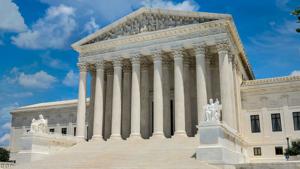
Supreme Court declines to hear public prayer case