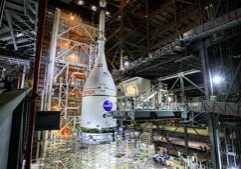
Artemis II mission breaks records Monday as astronauts observe far side of the moon
The astronauts of the Artemis II NASA mission made history just before 2 p.m. Eastern Monday when they traveled farther in their Orion spacecraft from the Earth than any humans have ever flown.
The previous record was set by the American spacecraft Apollo 13 in 1970.
A woman on the communications team at NASA Mission Control in Houston narrated the event as it occurred online. She braced the crew, everyone at Mission Control, and those watching online from around the world for the milestone.
“We are standing by for the Integrity crew aboard Orion to surpass the Apollo 13 record,” she said, just moments before.
She marked the occasion with a tribute to that crew and a message to the four astronauts aboard the Integrity.
“On April 15, 1970, during the Apollo 13 mission, three explorers set the record for the farthest distance humans have ever traveled from our home planet,” she said. “At that time, over 55 years ago, Lovell, Swigert and Haise flew 248,655 statute miles away from Earth. Today, for all humanity, you’re pushing beyond that frontier.”
The astronauts took the moment to challenge others to exceed their accomplishment.
“We choose this moment to challenge this generation and the next to make sure this record is not long-lived,” one of the male astronauts said.
They also named two “relatively fresh” craters on the moon – one, after their spacecraft, the Integrity, and the other after the deceased wife of crew member and commander Reid Wiseman.
Canadian Space Agency astronaut and crew member Jeremy Hansen read the message to Mission Control, choking back tears.
“Especially meaningful for this crew is a number of years ago, we started this journey in our close knit astronaut family, and we lost a loved one,” Hansen said.
He went on to describe a “bright spot” on the moon that can, at certain times, be seen from Earth. The crew named that spot Carroll. The astronauts could be seen wiping tears from their eyes, and Mission Control took a moment of silence.
The crew is now in their lunar flyby and formally began their observations around 2:45 p.m. They are slated to conclude their observations around 9:20 p.m.
During the flyby, they will photograph and describe the lunar surface from the Integrity, including areas of the far side of the moon never viewed by the naked eye. They’ll also experience “Earthset,” where the Earth disappears behind the moon from their perspective, reach their closest distance to the moon at 4,070 miles above its surface, and witness “Earthrise” and a solar eclipse.
They’ll also reach their farthest distance from Earth at 252,706 miles, more than 4,000 miles deeper into space than the Apollo 13 travelled.
The Artemis II mission began on April 1 and is a 10-day journey. It’s purpose is to build on the successful unmanned 2022 Artemis I mission and is NASA’s first crewed mission aboard the Space Launch System rocket and Orion spacecraft.
During the mission, the astronauts will test a number of features and functions of the spacecraft as well as monitor its automated activities. Their lunar observations are intended to inform future moon missions, aligning with President Donald Trump’s initiative of advancing American leadership in space.
The president wants Americans to return to the moon by the end of his term, establish a lunar outpost by 2030 along with a lunar nuclear reactor, establish greater security and military capabilities in space and prepare the way for trips to Mars.






Chance Showers And Thunderstorms
Latest News Stories

Democratic senators under fire explain why they supported GOP bill to end shutdown

Giannoulias ramps up campaign for state regulation of auto premiums

Illinois quick hits: Illinois U.S. senators split on shutdown vote

Meeting Summary and Briefs: Joliet Junior College Board of Trustees for October 2025

Will County Saves Nearly $5.74 Million in Bond Refinancing, Explores Future Borrowing Options

Will County Board Advances New Speed Limits in Green Garden and Frankfort Townships

New Lenox Garage Variance Denied After Neighbor Cites ‘Massive’ Scale and Neighborhood Impact

Library Board Adopts New Cell Phone Stipend Policy for Employees

Manhattan Announces Proposed 6% Property Tax Levy Increase
JJC Celebrates “Future Wolves” Partnerships with Joliet and Troy School Districts

State Veto Session Passes Energy Bill Limiting County Zoning, Approves Toll Hike for Mass Transit

Commission Approves Peotone-Area Farmhouse Split, Overruling Staff’s “Spot Zoning” Concerns

Will County Finance Committee Hits Impasse on 2025 Tax Levy, Postpones Budget Votes

Manhattan Park Board Tables Decision on Site Plan for Potential Development