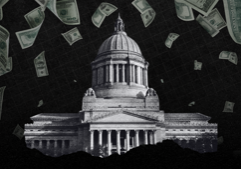
Report: U.S. added $1.2 trillion to national debt in six months
The U.S. government added $1.2 trillion to the national debt over the past six months, borrowing $163 billion during March alone, the Congressional Budget Office reports.
At the current rate of borrowing, federal deficits are on track to top $2 trillion by October, the end of the current fiscal year.
But the president’s recent budget request – which lawmakers will use as a blueprint for the 12 fiscal year 2027 appropriations bills – calls for $2.1 trillion in discretionary spending alone, without touching entitlement program spending.
“Both Congress and the President continue to ignore the urgent need to get our borrowing under control,” Maya MacGuineas, president of the Committee for a Responsible Federal Budget, said in a statement.
“As lawmakers consider the budget process for the upcoming fiscal year, we hope that they come up with plans to reduce deficits from the too-high 6% of GDP to a more sustainable 3% of GDP; secure our nation’s ailing trust funds for Social Security, Medicare, and highways; and ultimately fix the broken process that got us into this mess.”
Though CBO’s latest deficit estimate is $139 billion less than the amount recorded during the same time period last year, that is in large part due to increased tariff revenues and individual income or payroll taxes.
Federal spending, on the other hand, increased by $84 billion, mostly due to growing entitlement programs like Social Security, Medicare and Medicaid.
The government also collected 28% less in taxes from U.S. corporations over the last six months due to Republicans’ budget reconciliation bill – the “One Big Beautiful Bill” – which expanded deductions for certain corporate investments.
Yet despite repeated warnings from budget watchdogs, congressional action on soaring federal deficits and the over $39 trillion national debt ultimately hasn’t progressed past vigorous handwaving from a small group of Republicans.
Although the OBBB reduced federal spending by roughly $1 trillion over the next decade via entitlement program reforms, the savings only offset about a third of the bill’s $3.4 trillion ten-year cost.
Congress then sidestepped the automatic spending cuts to Medicare and other programs that are triggered by unpaid-for federal borrowing by wiping the Pay-As-You-Go (PAYGO) scorecard in November.
As House lawmakers return next week to begin hashing out appropriations funding and a second budget reconciliation bill, CRFB, the Cato Institute, and other budget watchdog groups are urging them to find at least $600 billion in savings.






Slight Chance Showers And Thunderstorms then Chance Showers And Thunderstorms
Latest News Stories

EEOC celebrates 200 days of protecting religious freedom under Trump
After Initial Rejection and Tense Debate, Board Reconsiders and Approves Contested DuPage Township Business

U.S. mining operations discarding rare minerals at center of trade talks

Duffy warns states to enforce English proficiency requirements for truckers

Illinois quick hits: Chicago businesses at 10-year low; school admin survey closes soon

Pritzker unveils Illinois LGBTQ hotline amid debate over transgender athletes

WATCH: Trump ends funding for cashless bail policies, hedges on Guard deployment to Chicago

Hochul pushes back on Trump’s cashless bail funding threat
Education Department finds GMU Violated Title VI
Redistricting opponents immediately appeal to CA voters
Former Transportation Secretary urges state taxpayer funding for Chicago transit

Illinois quick hits: Education tax benefits available; Giannoulias orders license plate reader to shut off access to CBP