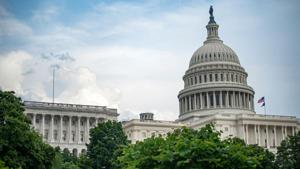
Murrill: Seismic decision vindicates congressional redistricting
Federal courts overstepped when they required the state to draw a second majority-Black congressional district, the U.S. Supreme Court ruled Wednesday in a high-stakes Louisiana redistricting dispute.
State Attorney General Liz Murrill called the ruling a “seismic decision,” saying it reaffirms equal protection principles and ends years of what she described as federal overreach.
“The Supreme Court has finally vindicated our original position,” Murrill said in a statement, adding that the case cost the state years of litigation and millions of dollars.
In Louisiana v. Callais, the justices rendered a 6-3 decision stating the lower courts went too far in directing Louisiana to rely on race in crafting its congressional map, emphasizing the Constitution limits when race can be used in redistricting.
The decision marks a significant clarification of how Section 2 of the Voting Rights Act of 1965 can be applied. Writing for the majority, the court said race-based line drawing is permissible only in narrow circumstances, particularly where there is clear evidence of intentional discrimination that must be remedied.
After the ruling, first-term Republican Secretary of State Nancy Landry referred to the case as “active litigation.”
“My lawyers are currently analyzing the opinion,” she wrote on social media. “We are limited in what we can say at this time as this continues to be active litigation with the case remanded for proceeding back to the Western District.”
Murrill, a Republican also in her first term, said the lengthy proceedings have been a nightmare “of federal courts coercing the state to draw a racially discriminatory map.”
“That was always unconstitutional,” she said, “and this is a seismic decision reaffirming equal protection under our nation’s laws.
“I vigorously defended our first map and said then that the only way to draw a second majority-minority district was to expressly take race into account. We raised our objections at that time to racial gerrymandering, but the District Court and the 5th Circuit directed us to draw the map anyway.”
The dispute began after Louisiana adopted a congressional map with one majority-Black district following the 2020 census. Civil rights groups challenged the plan, saying it diluted Black voting strength in violation of the Voting Rights Act.
A federal District Court, later backed by the 5th U.S. Circuit Court of Appeals, ordered the state to draw a second majority-Black district. State officials complied continuing to appeal, saying creation of a second such district would require unconstitutional racial gerrymandering.
In its ruling, the Supreme Court agreed that courts must apply strict scrutiny when race predominates in redistricting and cautioned against compelling states to adopt maps that prioritize race without sufficient justification.
Murrill said, “It is gratifying that the Supreme Court has finally vindicated our original position and, in doing so, clarified that only under very narrow circumstances – where there is proof of intentional discrimination – may race be used as a remedy under Section 2. It is frustrating that this has taken five years, millions of dollars, and many lost hours to get here.
“I will continue to work with the governor and the Legislature to provide guidance as we move forward to adopt a constitutionally compliant map.”





Showers And Thunderstorms Likely
Latest News Stories
Alleged Epstein 50th birthday letter from Trump released

WATCH: Bonta disappointed with U.S. Supreme Court ruling
Trump’s tariffs ‘not survivable’ for some U.S. small businesses

Postal traffic to U.S. dropped 80% after end of duty-free shipping

Illinois quick hits: Hundreds of layoffs reported; man charged with converted handgun

‘Glaring failure:’ Lawmaker accuses Meta of failing to make AI chatbots kid-safe

Medical training accreditor ends DEI policies, closes department
State rep says IL GOP will be outspent ’20 to 1′ in 2026 elections

Supreme Court allows ICE to factor race, workplace into L.A. raids

Op-Ed: Illinois just cemented its place as a ‘Legislative Inferno’

WATCH: DHS launches ICE ‘Midway Blitz’ in Chicago as Trump calls out cashless bail

Pritzker signs behavioral health data law amid privacy concerns