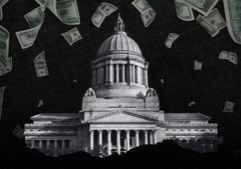
U.S. debt tops 100% of GDP, ‘deeply troubling’ for economy, national security
The U.S. national debt is now larger than the entire American economy and is only set to keep growing, further exacerbating the affordability crisis and risking national security.
Out of the $39 trillion total national debt, debt held by the public hit $31.27 trillion on March 31, surpassing the $31.22 trillion in Gross Domestic Product over the past 12 months.
The fact that the national debt has reached 100% of GDP – the highest in history except for the years immediately following World War II – is “deeply troubling,” Romina Boccia, director of budget and entitlement policy at the Cato Institute, told The Center Square.
“Following World War II, we actually had a good reason for having such a high debt, and the government was on a path to reduce that debt after the war ended,” Boccia said. “In this case, we have debt as high as since World War II, except we are on a steep upward trajectory, and it’s not driven by a temporary war but by permanent entitlement obligations that are expanding – that’s Social Security, Medicare and Medicaid.”
Social Security and Medicare spending alone made up more than 30% of federal outlays in fiscal year 2025, and that spending is projected to continuously increase in the near future.
While some U.S. lawmakers have expressed concern over the unprecedented debt increase, there is little to no action on substantially reducing federal spending.
Yet if Congress does not rein in deficits quickly, current and future generations of American taxpayers will feel the economic brunt of the rising interest costs that servicing the debt requires.
“The reason we concern ourselves with debt to GDP is primarily because of the burden it poses for current and future generations, and that is primarily measured in the interest costs that servicing the debt requires from working Americans and taxpayers,” Boccia said.
“There’s strong research indicating that when debt grows to such high levels, above 80% of GDP, it tends to crowd out private sector investment, which reduces economic growth, and therefore economic opportunities, jobs, and higher wages.”
In the immediate term, rising debt worsens affordability by spiking interest costs on Americans’ credit card debts, mortgages, car loans, student loans and more.
“The federal government is using up so much credit in the market that it’s driving up interest costs, and it affects all of us,” Boccia said. “It has these downstream effects.”
The U.S. currently spends more money on financing debt interest costs than it does on national defense – even as high debt ratios directly endanger national security.
“The reason we want governments to maintain low stable debt ratios, preferably below 60% of GDP, is so that they have room, so-called fiscal capacity, to borrow during times of crisis. And that can be a pandemic, a national security crisis, a financial crisis, or an economic recession like we saw in 2008,” Boccia said.
“When governments have that room to borrow for that emergency response, it means that their recessions aren’t as severe and they can more easily return to normal economic growth after the crisis ends,” she added. “But when a government enters a crisis already over-leveraged, holding too much debt, they’re not able to borrow as much as they otherwise would have in order to weather the crisis, and so the crisis will be more severe.”
In a situation where America is at war, the results would be disastrous.
“If you don’t have the fiscal capacity to respond to a military threat, then you are leaving yourself at risk of not being able to defend yourself,” Boccia said. The national debt is our greatest national security risk.”
Without major changes to federal fiscal policy, the U.S. government will default on its debt in about 20 years, according to Penn Wharton Budget Model estimates.






Partly Sunny
Latest News Stories
Postal traffic to U.S. dropped 80% after end of duty-free shipping

Illinois quick hits: Hundreds of layoffs reported; man charged with converted handgun

‘Glaring failure:’ Lawmaker accuses Meta of failing to make AI chatbots kid-safe

Medical training accreditor ends DEI policies, closes department

State rep says IL GOP will be outspent ’20 to 1′ in 2026 elections

Supreme Court allows ICE to factor race, workplace into L.A. raids

Op-Ed: Illinois just cemented its place as a ‘Legislative Inferno’

WATCH: DHS launches ICE ‘Midway Blitz’ in Chicago as Trump calls out cashless bail

Pritzker signs behavioral health data law amid privacy concerns

WATCH: Pritzker’s ‘move’ comments ‘insulting’ to Illinoisans, Freedom Caucus says
Lawmakers seek to offer immigrants temporary legal status

DEA surge nets drugs, 617 arrests, 420 firearms, $11 million in cash