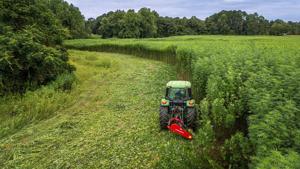
Green Garden Solar Project Cleared to Implement Higher “Agrivoltaic” Standards
Will County Planning and Zoning Commission Meeting | May 5, 2026
Article Summary: The Will County Planning and Zoning Commission approved four variances on Tuesday, May 5, 2026, to facilitate “agrivoltaics” at a proposed solar farm in Green Garden Township, allowing native plants to grow up to three feet tall. The decision permits USS Talamh Solar LLC to deviate from standard weed-control ordinances to meet the rigorous requirements of the Illinois Pollinator-Friendly Solar Site Act.
Pollinator Variance Key Points:
-
Specific Approvals: Variances V-26-115 through V-26-118 were approved in 5-2 votes, allowing ground cover height of 36 inches and reducing required mowings from five to four annually.
-
Environmental Justification: The higher growth is required for native Illinois species to self-pollinate, establish deep root systems for soil recharge, and improve water infiltration.
-
Scorecard Compliance: The developer must complete a “solar site scorecard” with the Illinois Department of Natural Resources (IDNR) to be officially recognized as a pollinator-friendly facility.
-
Wildlife Monitoring: As a condition of approval, the developer must work with the Will County Forest Preserve District to document and monitor wildlife mortality incidents on the 90-acre site.
JOLIET — Beyond the debate over solar panels and battery storage, the Will County Planning and Zoning Commission focused on the future of the soil itself on Tuesday, May 5, 2026, granting a series of variances that will transform a 90-acre farm field into a protected pollinator sanctuary.
The applicant, USS Talamh Solar LLC, successfully argued that standard county maintenance codes—which typically require frequent mowing and height limits for “weeds”—are incompatible with the biological needs of native Illinois prairie plants. To qualify for the state’s community solar program, projects must earn “points” via agrivoltaics, the practice of combining solar energy production with agricultural utility.
Scientific Basis for the Request
Harry Marwil, senior developer for US Solar, explained that the facility intends to plant deep-rooted native species underneath the 17,225 solar panels. ” Agrivoltaics would require pollinator plantings to be grown to 36 inches to establish properly,” Marwil testified.
Ryan Mioni, a civil engineer for the developer, added that these plants act as a natural defense against the very drainage issues neighbors fear. “Native pollinators have deep root systems that recharge agricultural soils, help water infiltration, and provide natural weed prevention,” Mioni said. He noted that the plants need the additional height to propagate effectively and self-pollinate.
The commission’s approval (V-26-115 and V-26-117) raises the allowable height of ground cover from the current 13-inch limit to 36 inches for both parcels involved in the project. Additionally, V-26-116 and V-26-118 reduce the mandatory mowing frequency from five times per year to four.
Forest Preserve and Agency Input
The variances were supported by a land-use analysis that noted the surrounding area already consists of agricultural fields where crops such as corn and soybeans frequently exceed 36 inches.
The Forest Preserve District of Will County provided a formal review of the plan. In a letter dated April 16, 2026, Real Estate Manager Em Wilcher encouraged the developer to utilize the IDNR Solar Site Pollinator Establishment and Management Guidelines. Wilcher requested that the site operator monitor the property for bird, mammal, and insect mortality, providing quality photographs and documented locations to the district.
Opposition and Resident Concerns
The variances were not without detractors. Commissioner Roger Bentonhausen and Commissioner Karen Warick provided the two dissenting votes on all four requests.
During public comment, Green Garden Township Supervisor Dean Christophilos argued that the “natural” look of a pollinator field would be a poor fit for a residential area. “It’s going to change the complexity of our township,” Christophilos said, noting the project’s proximity to a hundred-home subdivision.
Resident Melissa Taviger questioned the honesty of the maintenance plan, suggesting that reduced mowing was a cost-saving measure for the developer rather than an environmental benefit. “There are so many inconsistencies with what they’re proposing,” Taviger told the commission.
Ultimately, the board found that the environmental benefits of soil preservation and stormwater management outweighed the aesthetic concerns of the township. The variances passed 5-2, moving the project forward to the full County Board for final deliberation.





Showers And Thunderstorms Likely
Latest News Stories
Library Board Authorizes Online Bill Pay and Formalizes Friends of the Library Agreement
Joliet Unity Movement Criticizes Board’s Handling of Cannabis Tax Revenue

Safety Upgrades Planned for Wilmington-Peotone Road; Gas Line Proposal Rejected
Manhattan Trustees Approve 2025 Property Tax Levy
Tensions Flare as Board Members Clash Over Budget Process and Protocol
Will County Board Approves $2.7 Million Reserve Draw to Finalize 0% Tax Levy
Manhattan-Elwood Library District Board Approves 2026-2030 Strategic Plan and Tax Levy
Manhattan Annexes Historic Round Barn Farm; Plans for Wedding Venue Move Forward
Jackson Township to Hear Proposal for Manure-to-Gas Energy Facility
Meeting Summary and Briefs: Manhattan School District 114 for November 12, 2025

Meeting Summary and Briefs: Lincoln-Way Community High School District 210 for November 20, 2025

Meeting Summary and Briefs: Manhattan Park Board for October 2025