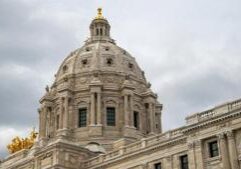
Exclusive: GOP defends report, points to Walz administration failures on fraud
The Republican-led Minnesota House fraud prevention and state oversight committee adopted its majority report on Wednesday, concluding a two-year review of alleged fraud across multiple state programs.
The report summarized hearings held during the 2025–2026 legislative session and outlined what Republicans describe as “widespread” vulnerabilities in state-administered programs, including Medicaid waiver services, child care assistance and other public benefits programs.
“The report outlines the ‘anatomy of fraud’ and the failure of the Walz administration to take action,” said state Rep. Kristin Robbins, R-Maple Grove, who chairs the committee.
Robbins said the committee’s work revealed what she described as systemic issues across agencies and called for continued reforms, even though the committee is adjourning.
“The scope of the fraud is staggering,” Robbins said during the committee’s final meeting. “I hope the findings and recommendations are taken seriously. We have made enormous progress in exposing fraud, strengthening internal controls and bringing a culture of accountability to state government, but there is more work to do.”
Two Years in the Making
The committee was created in January, 2025 as part of a House power-sharing agreement after the chamber was tied. It was the first oversight committee of its kind in Minnesota legislative history and was tasked with holding hearings on fraud prevention and agency oversight.
In late November, a firestorm erupted in the state following the release of reports alleging that millions of taxpayer dollars had been fraudulently stolen from Minnesota’s welfare system and then sent to the Somali-based terror group Al-Shabaab.The revelations drew national attention to the state, with independent and federal investigators estimating that the potential value of fraud schemes could range between $9 billion and $20 billion.
During the committee’s lifetime, lawmakers reviewed testimony from dozens of witnesses, whistleblower complaints and prior Office of the Legislative Auditor reports.
The report concludes that fraud spanned multiple programs and agencies and that existing safeguards were insufficient to prevent abuse. It also argues that patterns of fraud were repeated across programs, including child care assistance and Medicaid waiver services, and that and Democrat administration officials failed to act quickly enough to prevent losses.
“The Walz Administration ignored and consciously downplayed shocking levels of fraud,” it states.
Robbins said the committee identified what she called an “anatomy of fraud” or “business model of fraud,” which she said should help agencies identify and stop future schemes earlier.
“We’ve seen the same pattern over and over and over,” Robbins said during the hearing. “We have to clamp down on it right away.”
The report further states that lawmakers believe fraud prevention tools such as prepayment reviews, unannounced inspections and earlier risk designations could have reduced losses if implemented sooner.
Partisan Opposition
Democratic lawmakers on the committee strongly objected to both the report’s conclusions and the process used to adopt it – as well as the existence of the committee itself.
Rep. Dave Pinto, DFL-St. Paul, said the document was released less than 24 hours before the vote and criticized Republicans for not allowing time for review or edits.
“This document came together without any input, any review, anything from three of the eight members of the committee,” Pinto said. “I don’t know what the point is of why we’re even voting.”
Pinto also disputed claims made in the report regarding officials in the Walz administration, arguing that state and federal prosecutors have pursued fraud cases and that the report mischaracterized the scope of those efforts.
Rep. Emma Greenman, DFL-Minneapolis, added the committee’s work had drifted away from fraud prevention for a broader political agenda.
“This committee is called the Fraud Prevention and Government Oversight Committee, not the make the case and picture what you think the Democratic Party is,” Greenman said.
She also argued that fraud prevention work was occurring in other legislative committees and that bipartisan efforts on anti-fraud legislation were already underway outside the oversight panel.
“This report turned into . . . no Democratic leader left un-disparaged,” Greenman said. “That’s not a good use of state dollars. And it’s not actually taking seriously the problem.”
Republicans pushed back, arguing the committee’s role was to investigate fraud patterns rather than pass legislation directly, and said the report was necessary to document findings and recommendations.
Rep. Pam Altendorf, R-Red Wing, defended the committee’s work.
“This was exposure of what had to be shown to the public in order to will for change,” Altendorf said. “What I don’t see from the Democrat Party, from the Walz administration, is accountability.”
The committee voted to adopt the majority report with four votes in favor and two abstentions, both from the Democrat members on the committee.
Robbins Interview
Robbins, in an exclusive interview with The Center Square following the vote, said the committee was designed to function similarly to congressional oversight bodies, which typically issue separate majority and minority reports.
She said Republican members provided advance notice of the report and invited participation in a minority report but said Democrats declined to produce one.
“They decided not to do that, and then they wanted to somehow amend or make changes to the majority report,” Robbins said. “That’s just not how these things work.”
Robbins added Republicans followed standard oversight practice.
“So I thought it was disappointing that they were calling foul on the process,” she said. “The process is very clear. They were just choosing to not follow it.”
Robbins applauded the scope of findings uncovered over two years, citing whistleblower reports and testimony.
“We, through the whistleblowers, really did uncover how there had been a cover up,” she said, referencing allegations involving agency responses to fraud reporting. “They weren’t just sort of unaware of the fraud. They were aware of it and actively allowing it to continue or suppressing people who are trying to call it out.”
Robbins said the committee’s report is meant to serve as a foundation for future legislative efforts, even as questions remain about whether the oversight panel will continue in the next session.
“There are many vectors of fraud we didn’t even get to,” Robbins said. “And that’s concerning.”
She added the future of the committee itself will depend on which party controls the House in coming sessions.
“If Republicans are in charge, we absolutely will have another fraud committee,” she said. “If the Democrats get control, I would doubt they do it.”
Robbins said the committee will continue working in a limited capacity even after adjournment, particularly through whistleblower reports and ongoing investigative leads.
“Our staff is continuing to work,” she said. “Our committee will continue to investigate the things we’ve been working on, and then turn those credible findings over to our law enforcement partners.”
Robbins explained that the majority report is intended to function as a long-term record of the committee’s work and findings, particularly given the uncertainty around whether the panel will be reconstituted.
“If this is the only session in the history of the Minnesota Legislature where we actually had the guts to have an oversight committee, I want there to be a record of our work,” Robbins said.
Robbins said the broader goal of the committee’s work extends beyond individual cases of fraud and into what she described as a needed shift in state governance and accountability.
“Minnesota is a fantastic state, and yes, we have a massive fraud problem,” Robbins said. “But now we know. We have exposed the fraud . . . but what we really need is a culture change.”
Robbins said that change could come in the November election.
“That is going to come through political leadership, where we have political leaders held accountable for turning a blind eye, for enabling fraud, for even trying to suppress the allegations of fraud,” she said. “We’re getting the criminal accountability on the fraudster side through the federal prosecutions . . . But we need political accountability, and that’s what the public is still waiting for.”
Robbins said she hopes the committee’s report contributes to that shift going forward, but that she believes voters will ultimately determine whether that shift occurs.
“I hope the citizens of Minnesota will deliver that in November,” Robbins said. “Because the culture change will have to come from electing leaders who are going to hold agencies and the executive branch accountable.”

Showers And Thunderstorms Likely
Latest News Stories

WATCH: Pritzker alleges Trump election interference; tells disgruntled residents to move
Illinois quick hits: Foreign national indicted for fraud; Chicago Public Schools budget approved
Meeting Summary and Briefs: Jackson Township Board for July 9, 2025
CA Supreme Court rejects GOP bid to stop redistricting

Lawsuit links CA teen’s suicide to artificial intelligence
Your Ultimate Guide to the 2025 Frankfort Fall Fest: Everything to Know for the Nationally-Ranked Event
HHS, Department of Education announce nutrition reforms
White House appoints interim CDC director; standoff continues with former director
WATCH: Pritzker claims Trump plans election interference with troop deployment

Plaintiffs take Cook County gun ban challenge to SCOTUS
Illinois quick hits: $1.57B return on investments; solar-powered manufacturer cuts ribbon
Report: Illinois U.S. Rep faces minimal penalty after disclosure violations