Will County Hears Proposal to Establish County-Focused Land Bank for Distressed Properties
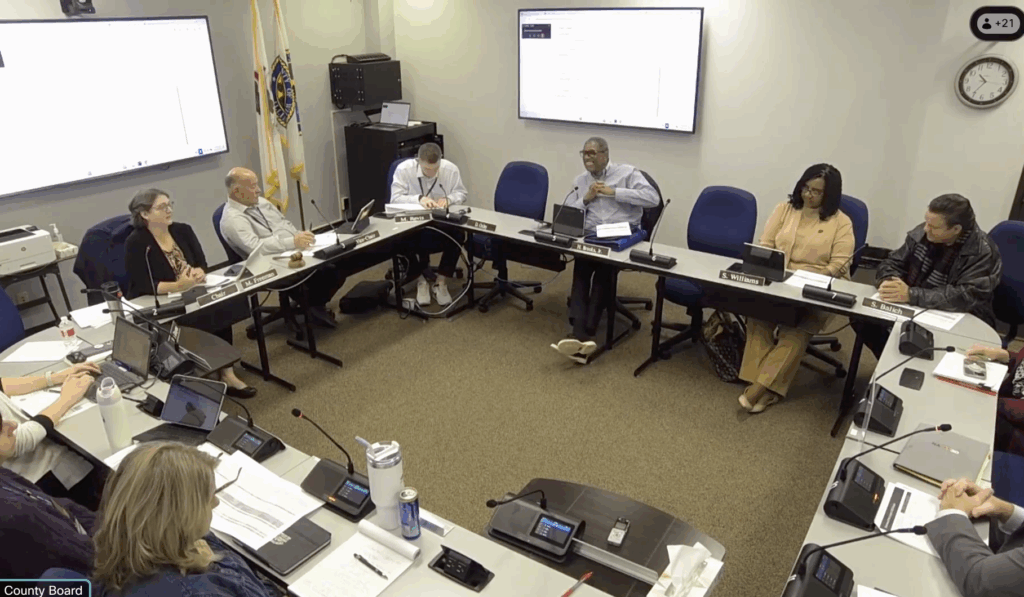
Will County Board Executive Committee Meeting | May 14, 2026
Article Summary: The Will County Board Executive Committee on Thursday, May 14, 2026, heard an introductory presentation from Will County Center for Economic Development official Doug Pryor on the possibility of establishing a Will County-focused land bank to return tax-delinquent, abandoned and vacant properties to productive use. The discussion was informational only, with no vote taken; the proposal is expected to return to a future committee meeting for further consideration.
Will County Land Bank Key Points:
- Pryor’s proposal would create a single-purpose entity through intergovernmental agreement under the Illinois Land Bank Act, with no request for county operating subsidy or new staff.
- Land banks already operate in Cook, Lake, DuPage and Kankakee counties, along with several regional partnerships in northern Illinois.
- Several executive committee members raised detailed concerns about board structure, institutional-investor participation and the loss of county control over distressed property.
- The proposal will return to the executive committee, with member Julie Berkowicz suggesting it warrants a committee-of-the-whole discussion.
WILL COUNTY — The Will County Board Executive Committee on Thursday, May 14, 2026, opened an initial discussion on whether to establish a Will County land bank to acquire and reposition distressed, vacant, abandoned and tax-delinquent properties around the county. The presentation, identified on the agenda as item 26-4802, was led by Doug Pryor of the Will County Center for Economic Development and required no vote.
Pryor told members a land bank is a public or not-for-profit entity narrowly focused on returning problem properties to productive ownership rather than holding land long-term. “These aren’t eminent domain vehicles,” he said. “They’re not going and taking properties. Rather, they are properties that are already abandoned.” Under the Illinois Land Bank Act, such entities are typically structured as intergovernmental agreements with a not-for-profit operator, with board representation drawn from both public and private stakeholders.
The proposal carries no request for an operating subsidy or a new county department, Pryor said. Instead, the county would adopt an enabling ordinance, coordinate tax foreclosure and extinguishment processes, and provide oversight and governance representation. Individual municipalities would decide for themselves whether to participate through separate intergovernmental agreements with the land bank.
Pryor noted that the county currently averages slightly fewer than 3,000 tax sales each year, but that the existing tax sale tool moves properties immediately to auction without offering a strategic redevelopment pathway. Land banks, he said, address fragmented ownership, tax and title complications and limited municipal capacity to redevelop distressed areas. Comparable programs already exist in Cook, Lake and DuPage counties, as well as in Kankakee and northern Illinois.
David Oxley said Will County had operated a similar program several years ago through the Land Use Department under former administrator Tim Mack, focused on rehabilitating foreclosed homes in distressed neighborhoods. Traynere, the chair of the ad hoc Ordinance Review Committee, said she had reviewed similar materials recently and supports moving forward, while noting she wanted to understand how investors and grant funding could support the program without a direct county appropriation.
District 10 member Julie Berkowicz pressed Pryor on the structure of the governing board, including who would sit on it and whether institutional investors might participate. “Our neighborhoods today and for the last 25 years have been struggling with the impact of institutional ownership in our subdivisions,” Berkowicz said. Pryor responded that the structure would be defined in the enabling ordinance and intergovernmental agreement and would be brought before the board for review and a future vote. “Like at the end of the day, it’s not designed to serve large industrial or large capital investors,” he said. “It’s designed to have local regional experts.”
Berkowicz suggested the matter warrants a committee-of-the-whole discussion when it returns for action, and asked that staff provide copies of enabling agreements from neighboring counties for board review. Mica Freeman, who chairs the Capital Improvements and Information Technology Committee, said she could think of several properties in her district that might benefit and pledged to keep watching the proposal as it advances. Pryor said no formal vote was being sought at this meeting and that staff intends to bring a draft enabling ordinance and intergovernmental agreement back to the committee at a future date.



Partly Sunny
Latest News Stories

Illinois quick hits: DHS responds to migrant release order

As Trump considers rolling back some tariffs, trade groups want in
New Mexico attempts to counter Trump’s deportation agenda

WATCH: Newly released Epstein emails discussing Trump ‘prove nothing,’ says Leavitt

Small business leader warns swipe fees are squeezing local stores

Pritzker disagrees with Durbin on vote to end shutdown

Pritzker open to conversation with Trump on alderman’s immigration proposal

Expert: Illinois’ outdated tax law leaves homeowners, taxpayers on the hook
Illinois quick hits: Midway Blitz nabs nine drunk drivers; Madigan prosecutor to depart

Meeting Summary and Briefs: Manhattan-Elwood Public Library District Board for September 2025

Lawmakers divided after federal complaint targets student mental health screening law

Normal, IL fire and EMS challenges highlight need for statewide task force
Analysis: Chicago among worst cities to drive in