
Op-Ed: Illinois is closed for business
The policies coming from Springfield send a clear message: Illinois is closed for business. While other states enact pro-growth policies and create economic opportunity, Illinois is weakening the market forces that once powered its growth. As a result, businesses and individuals are fleeing the state, further weakening economic conditions and pushing the state further towards a fiscal cliff.
The recently-released 19th edition of Rich States, Poor States, co-authored by native-Chicagoan Steve Moore, Dr. Arthur B. Laffer, and Jonathan Williams, ranks the Land of Lincoln 45th for economic outlook. Illinois has the eighth-highest corporate tax rate, sixth-highest property tax rate, and sixth-highest burden across all other minor taxes. Poor fiscal stewardship is reflected in it having the second-highest unfunded pension liabilities per capita and sixth-highest debt service costs. The prohibition on graduated income taxes in the state’s constitution is perhaps the only bright spot.
These policy choices have led residents to vote with their feet. Since 2016, more than 900,000 Illinoisans have left for one of the other 49 states. Their top destinations are Florida, Wisconsin, Texas, Indiana and Missouri.
One of the most destructive policy choices the state has made is its Interchange Fee Prohibition Act. Passed in 2024, the law prevents banks and payment networks from collecting interchange fees on the tax and tip portions of credit card transactions. It would require overhauling payment infrastructure never designed to separate transactions at that level, driving up compliance and implementation costs across the board.
The attempt to regulate interchange fees captures exactly the sort of top-down economic management that is driving opportunity elsewhere. Interchange fees underpin the electronic payments system — ensuring swift processing, protecting against fraud, and funding rewards programs used by 31.6 million Illinoisans. This is not a product of taxpayer dollars or government fiat, but an innovation of private industry that Springfield seeks to tear down.
The law has faced legal challenges and has yet to take effect — the Office of the Comptroller of Currency recently issued an interim final rule preempting the state law and reaffirming that fee practices of national banks are governed by federal standards. Notably, comptrollers of both parties, including under the Biden administration, have opposed the IFPA, underscoring that this is bad policy by any measure. The consequences have been stayed for now, but the troubling message has already been sent.
The cumulative effect of uncompetitive policies is to drive commerce out of the state. Chicago was once the proud capital of the Midwest; today it is seeing an exodus of businesses to more competitive states. Boeing moved its headquarters from Chicago to Northern Virginia in 2022, and when the company recently announced it would return some operations to the Midwest, it selected St. Louis. Caterpillar, in Illinois since the 1930s, fled for Texas. The hedge fund Citadel left for Florida. Tyson Foods moved from Chicago to Northwest Arkansas. These high-profile departures reflect a policy environment hostile to innovation and growth, and as workers and businesses leave, those who remain have fewer opportunities.
Illinois and the contrast with other states in the region illustrates that decline is a choice. Ohio had been an outmigration state for as far back as reliable data are available, but broke that trend in 2023 and now has a 2.75% flat personal income tax. Indiana has remained in the top 10 of the Rich States, Poor States index since 2014 and seen consistent in-migration since 2018. The Hoosier State is more competitive than Illinois across nearly every critical economic policy variable, including right-to-work protections, a 2.95% personal income tax, no estate tax, and a 4.9% corporate income tax (4.6 points lower than Illinois). Tennessee has become one of the most dynamic, pro-growth economies in the nation as a zero-income-tax state, attracting more than 450,000 net new residents since 2019.
Outmigration reduces economic opportunity and exacerbates Illinois’s fiscal challenges. Fewer workers mean fewer taxpayers, forcing ever-growing tax burdens on the private economy to fund public services and pay off decades of pension underfunding. The state risks a vicious cycle of outmigration, deficits, and tax increases.
The current prognosis is dire, but the future need not be. By enacting competitive policy and embracing the free market, other states have unleashed their economies, attracted workers, won investment, and created opportunity. Just as policy choices are weighing on Illinois today, pro-growth policies could power an economic comeback.




Slight Chance Showers And Thunderstorms
Latest News Stories

Manhattan Police Department Promotes Garrison to Commander, Diaz to Sergeant

Meeting Summary and Briefs: Manhattan Fire Protection District for August 18, 2025

Village of Manhattan Honors St. Joseph’s Catholic School on its 100th Anniversary

JJC Board Approves Contract with Adjunct Faculty Union
Manhattan Awards $547K Contract for US 52 Infrastructure Extension to Spur Growth

Fire District to Address Safety at High-Accident Intersections with County DOT

Meeting Summary and Briefs: Manhattan Township for August 2025

Manhattan Eyes Major Water and Sewer Rate Hikes to Fund Over $50 Million in Infrastructure Projects

JJC Board Approves Student Trustee Quorum Policy Amid Heated Debate
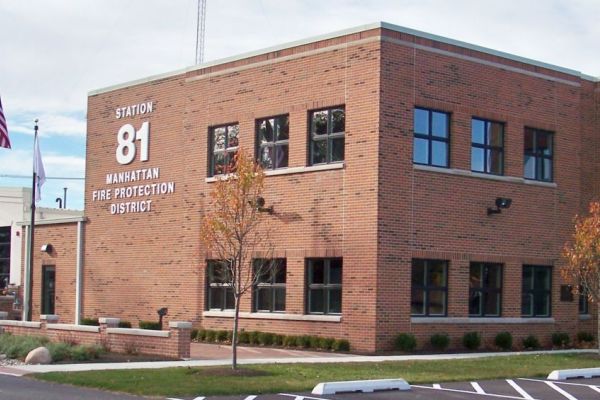
Manhattan Fire District Approves Rebid Packages for New Station, Saving Nearly $200,000

Manhattan Township Board Approves Holiday Support Letter in 4-1 Vote
Manhattan Township Seniors Could Benefit from Proposed State Property Tax Relief