SCOTUS turns down Eli Lilly bid to end ‘bounty hunter’ lawsuits
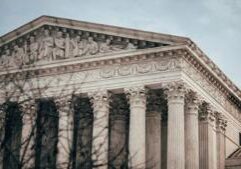
The U.S. Supreme Court has turned aside the bid by pharmaceutical maker Eli Lilly to not only toss out a $183 million judgment against the company, but also put a dent in a system the company says unconstitutionally permits “private bounty hunters” to use questionable legal claims to extract big paydays in the name of the government.
On May 18, the high court formally denied Eli Lilly’s appeal petition.
The denial of Eli Lilly’s appeal came without dissent or comment from the justices.
Eli Lilly had petitioned the Supreme Court in March, seeking to overturn a decision from the U.S. Seventh Circuit Court of Appeals in Chicago.
The Seventh Circuit had upheld a federal court jury’s verdict, ordering Lilly to pay $183 million, purportedly to compensate the government for fraud allegedly committed by the drug maker when the company allegedly reported false drug costs to Medicaid under a drug rebate program.
But the company sought to do more than just reverse a contrary verdict. The petition asked the Supreme Court to declare the federal False Claims Act, the law under which the lawsuit was filed, unconstitutional. Lilly argued the law effectively allows the federal government to create opaque regulations that leave businesses guessing on how to comply, but yet still empowers “bounty hunting” trial lawyers to enforce them, using questionable legal theories of fraud, even after the government declares itself unwilling to sign on.
In the petition, Lilly compared the arrangement to “Calvinball,” a notorious and maddening fictional game invented in the frames of the “Calvin and Hobbes” comic strip by cartoonist Bill Watterson. In the game, the titular fictional character, Calvin, simply made up the rules of the game as it is played.
The lawsuit at the the heart of the filing was filed against Lilly in 2014 by alleged whistleblower Ronald Streck.
Streck and attorney Dan Miller and others from the firm of Walden Macht Haran & Williams, of New York, had filed suit in Chicago federal court in 2014, more than a decade earlier.
The lawsuit, however, did not accuse Eli Lilly of harming Streck. Rather, Streck brought the claims as a so-called qui tam action under the False Claims Act.
In such an action, a plaintiff, known as a “relator,” files suit on behalf of the federal government, pressing claims of fraud against defendants. In the action, the plaintiff-relator seeks to recover money allegedly not paid to the government or allegedly paid out by the government as a result of alleged fraud.
Qui tam relator plaintiffs are then typically entitled to a cut of whatever sums may be ultimately recovered by the government through their lawsuit.
In this case, Streck claimed he, as an alleged knowledgeable whistleblower, was attempting to recover millions of dollars allegedly shorted to the federal government by Eli Lilly under the Medicaid Drug Rebate Program.
The lawsuit accused Eli Lilly of allegedly underreporting the price it charged for certain medications to the program. Under the program’s rules, drugmakers are required to report to Medicaid the average price of drugs included in the program.
However, in the lawsuit, Streck, identified as a former executive of a network of regional drug wholesalers, asserted Eli Lilly reported only the drugs’ initial price, and did not include later price increases in the calculations.
That allegedly allowed Eli Lilly to “claw back” those price increases, allegedly forcing the government to pay more, while allowing the company to allegedly pocket hundreds of millions more in profit over the years.
According to court documents, Eli Lilly reportedly stopped the practice in 2017, shortly after formally and clearly notifying the federal government of its clawback practices.
However, the jury still ordered the company to pay $183 million.
Under the False Claims Act, Streck would be entitled to claim as much as 25% of that amount, with his attorneys claiming still more.
On appeal, the Seventh Circuit judges agreed Eli Lilly may not have meant “to mislead the government” and did their best to comply with the complex regulations.
But the judges said the company should still be required to pay nearly $200 million, because jurors were not wrong to conclude “Lilly knowingly hid the truth” from the government, allegedly “amassing over $600 million in revenue,” while it allegedly “deprived the government of over $60 million,” allegedly as a result of the company’s practices.
On appeal to the Supreme Court, Lilly said the Seventh Circuit’s ruling creates a “trap for the unwary” and particularly for “manufacturers who begged regulators for guidance and hewed to judicially approved legal constructions,” yet were still hit with big judgments, anyway.
Others filed briefs supporting Lilly’s position, including the U.S. Chamber of Commerce.
The Chamber argued the Supreme Court should take the case and strike down the qui tam provision under the FCA.
The Chamber asserted the FCA qui tam provision “runs roughshod” over constitutional “safeguards,” preventing private litigants from using the courts to profit in the name of the federal government.
The Seventh Circuit’s decision “flouts our legal system’s commitment to fair notice and due process, and allowing it to persist will only encourage further qui tam overreach,” the Chamber wrote in its brief in support of Lilly.
In response, Streck’s legal team argued the appeal amounted to an attempt by Eli Lilly to persuade the Supreme Court to undo the company’s own legal “blunders” and overturn a reasonable jury verdict.
“There is no reason for this Court to reweigh the evidence and thereby second-guess the jury’s fact-bound conclusion,” wrote Streck’s lawyers, now joined by attorney Jackson Martin, of Tysons Corner, Virginia.
The Supreme Court sided with Streck and denied Eli Lilly’s petition.
Eli Lilly was represented before the U.S. Supreme Court by attorneys John C. O’Quinn and Luke P. McGuire, of the firm of Kirkland & Ellis, of Washington, D.C.; and Erin E. Murphy, Matthew D. Rowen and Julia R. Grant, of Clement & Murphy, of Alexandria, Virginia.


Showers And Thunderstorms Likely
Latest News Stories
Lincoln-Way Board Weighs Community Solar Program Promising $155,000 in Annual Savings
Will County Reverses Zoning on Peotone Farmland to Facilitate 10-Acre Sale

Meeting Summary and Briefs: Joliet Junior College Board of Trustees for September 10, 2025

Manhattan Park Board Hires New Architect for Round Barn Buildout, Secures Annexation for Future Banquet Hall
Lincoln-Way 210 Board Approves $172.7 Million Budget with Planned Deficit for Bus Purchases
Manhattan School District 114 Approves $41.5 Million Budget for FY26

Manhattan Fire District Advances New Station with $8.75M Bond Hearing, Approves Contracts with $194,000 Savings

Will County to Pay Enbridge $82,000 to Relocate Pipeline Equipment for Exchange Street Improvements
Laraway Road Widening Project in New Lenox and Frankfort Gets Additional $468,000 for Redesign

“Federal Policy Uncertainty” Blamed for Delay of Peotone Solar Farm; County Grants Second Extension
Will County Grants Extensions to Five Solar Projects Sold to New Developers
Will County Board Approves Controversial Drug Recovery Retreat in Crete Township