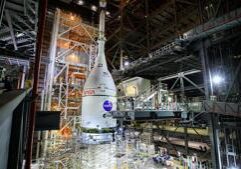
NASA reorganizes to accelerate Moon Base, lunar programs
NASA announced a reorganization of the agency Friday, restructuring key mission directorates to accelerate its lunar exploration program even as Congress and the White House remain divided over the agency’s $24.4 billion budget.
NASA said it will consolidate its human spaceflight and space operations directorates into a single Human Spaceflight Mission Directorate and merge its aeronautics and space technology offices into a new Research and Technology Mission Directorate. The Science Mission Directorate will remain unchanged.
“There will be no reduction in force, no program cancellations, no closures, but we will achieve cost savings through more efficient execution,” NASA Administrator Jared Isaacman said in a statement. “This is how we deliver on the mission, meet the moment, and continue to make history on behalf of the American people.”
The restructuring comes as NASA faces a contested budget request in Washington. The White House has proposed cutting the agency’s budget from $24.4 billion to $18.8 billion – a 23% reduction – while the House Appropriations Committee has advanced legislation keeping funding flat, rejecting the administration’s request.
Under the changes, mission directorates will now report directly to Isaacman rather than through the associate administrator, a move the agency said would streamline decision-making and improve coordination across NASA’s centers and international partnerships. The associate administrator will also serve as NASA’s chief engineer under the new structure.
NASA said the realignment implements directives under the National Space Policy, including acceleration of the Artemis program and development of a lunar base.
NASA also named Carlos García-Galán as program manager for its Moon Base effort within the Human Spaceflight Mission Directorate, according to the agency.
NASA is expected to provide additional details on its lunar exploration strategy during a news conference Tuesday in Washington featuring Isaacman and other senior officials. In March, Isaacman said NASA planned to invest about $20 billion over seven years to support development of a long-term lunar base.
The United States and China are racing to land astronauts on the moon. Isaacman told lawmakers in April that the competition could be decided “in months, not years,” and warned that China is aiming to reach the lunar surface before the end of the decade.
The Senate is expected to take up its own NASA spending legislation in June, setting up negotiations with the House later this year over the agency’s final funding levels and the future of its lunar exploration plans.
Offices for Rep. Brian Babin, R-Texas, and Sen. Ted Cruz, R-Texas, did not immediately respond to requests for comment.






Partly Sunny
Latest News Stories

Millions Approved for Will County Highway and Road Infrastructure Projects

U.S. House OKs Fetterman bill allowing SNAP to cover hot rotisserie chicken

Gas hits $6 a gallon in California; Southwest see increases

Teacher unions spent over $1B on political causes since 2015

Illinoisans may soon need registration, title, license to use e-bikes, scooters
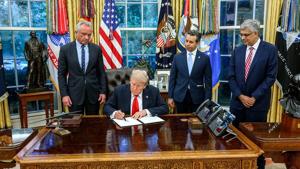
Executive order creates website for retirement accounts, matching federal contributions

Congress extends govt. surveillance powers for 45 days

Report: 10% credit card cap could cut off 64 million Americans, risk recession

Pritzker’s commission report pushes for local investigations of federal ‘brutality’

WATCH: Trump ‘probably’ considering pulling U.S. troops out of Italy, Spain

Illinois mulls change allowing pension investment in anti-Israel companies

Gun rights advocate questions Illinois ballistic imaging plan