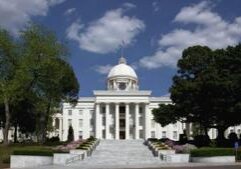
Federal judges temporarily block Alabama redistricting map
A panel of federal district court judges temporarily blocked Alabama’s plan to enact its 2023 congressional map for upcoming elections.
The Alabama legislature moved to implement its 2023 congressional map after the U.S. Supreme Court weakened section two of the Voting Rights Act, a provision designed to create more majority-minority congressional districts across the country.
Alabama moved to use an older congressional map that would change boundaries in four congressional districts throughout the state. The state planned to hold special primary elections in the four districts on Aug. 11, costing taxpayers $4.45 million.
Alabama held primary elections on May 19 in three U.S. House districts not effected by the redistricting push, U.S. Senate and other statewide races.
Federal judges in the Northern District Court of Alabama said the state’s map “intentionally discriminated based on race in violation of the Constitution.” They argued that the state legislature intentionally enacted a plan to dilute Black voting power in Alabama by moving forward with the 2023 maps.
In Lousiana v. Callais, the U.S. Supreme Court struck down Louisiana’s proposed congressional map and created two majority-Black districts in the state. Justices on the high court said Louisana’s congressional map was an unconstitutional racial gerrymander.
A coalition of Black voters and Democrat organizations argued Alabama’s 2023 congressional map was unconstitutional before the high court’s decision limiting the Voting Rights Act.
“Plaintiffs, members of the Alabama NAACP, and many other voters who have already cast ballots in the primaries will face irreparable harm if their votes are not counted,” lawyers for the Black voters wrote.
Justices on the U.S. Supreme Court previously allowed Alabama to move forward with its 2023 congressional map after it’s decision in Louisiana v. Callais.
Judges on the federal court argued voters in Alabama were faced with “irreparable harm” if they did not allow for the voting plan to be altered.
“Discriminatory voting procedures in particular are the kind of serious violation of the Constitution and the Voting Rights Act for which courts have granted immediate relief,” the federal judges wrote.
The federal court’s decision will likely return to justices on the U.S. Supreme Court to adjudicate with which map Alabama may move forward.




Chance Showers And Thunderstorms
Latest News Stories
Trump says he plans to rename Department of Defense
WATCH: Trump moves to end cashless bail in D.C., nationwide

Five incidents of swatting college campuses drawing concern

WATCH: Chicago reacts to Trump’s public safety push; AI in schools; rural health care

Will County Board Approves New Fee Schedule for Recorder of Deeds
Illinois expands campus abortion access, shields doctors from legal risk

Illinois quick hits: Human trafficking enforcement; health care fraud division announced
Nonprofit files complaints against Trump attorneys but almost no public discipline

Jackson Township to Hear Proposal for Manure-to-Gas Energy Facility
Everyday Economics: Softer tape, PCE in focus, and the Fed’s next move

Meeting Summary and Briefs: Manhattan School District 114 Board of Education for August 13, 2025

Marine’s mother takes on troop transport duties for family visits