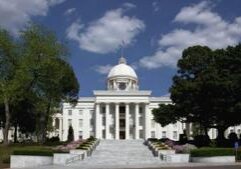
Federal judges temporarily block Alabama redistricting map
A panel of federal district court judges temporarily blocked Alabama’s plan to enact its 2023 congressional map for upcoming elections.
The Alabama legislature moved to implement its 2023 congressional map after the U.S. Supreme Court weakened section two of the Voting Rights Act, a provision designed to create more majority-minority congressional districts across the country.
Alabama moved to use an older congressional map that would change boundaries in four congressional districts throughout the state. The state planned to hold special primary elections in the four districts on Aug. 11, costing taxpayers $4.45 million.
Alabama held primary elections on May 19 in three U.S. House districts not effected by the redistricting push, U.S. Senate and other statewide races.
Federal judges in the Northern District Court of Alabama said the state’s map “intentionally discriminated based on race in violation of the Constitution.” They argued that the state legislature intentionally enacted a plan to dilute Black voting power in Alabama by moving forward with the 2023 maps.
In Lousiana v. Callais, the U.S. Supreme Court struck down Louisiana’s proposed congressional map and created two majority-Black districts in the state. Justices on the high court said Louisana’s congressional map was an unconstitutional racial gerrymander.
A coalition of Black voters and Democrat organizations argued Alabama’s 2023 congressional map was unconstitutional before the high court’s decision limiting the Voting Rights Act.
“Plaintiffs, members of the Alabama NAACP, and many other voters who have already cast ballots in the primaries will face irreparable harm if their votes are not counted,” lawyers for the Black voters wrote.
Justices on the U.S. Supreme Court previously allowed Alabama to move forward with its 2023 congressional map after it’s decision in Louisiana v. Callais.
Judges on the federal court argued voters in Alabama were faced with “irreparable harm” if they did not allow for the voting plan to be altered.
“Discriminatory voting procedures in particular are the kind of serious violation of the Constitution and the Voting Rights Act for which courts have granted immediate relief,” the federal judges wrote.
The federal court’s decision will likely return to justices on the U.S. Supreme Court to adjudicate with which map Alabama may move forward.


Partly Sunny
Latest News Stories
Taxpayers fund factories Pentagon says contractors should build
Renewed call for Trump to pardon Texas Republican political consultant

Op-Ed: Illinois is closed for business

Illinois Quick Hits: Proposal would allow two-year, online car registration
Meeting Summary and Briefs: Will County Board Executive Committee for May 14, 2026
Flint, Detroit top list of most-affordable U.S. cities for homebuyers
SCOTUS turns away Palatine HS teacher fired over anti-BLM Facebook posts
WATCH: Critics say political protests interfere with education
Congressional candidates discuss agriculture, healthcare
Trump admin still releasing minors into U.S., well below Biden era

TrumpRx expanding, offering generic prescription drugs
Trump pauses planned military strikes against Iran, cites further negotiations