
Mullin defends $118B Homeland Security budget request
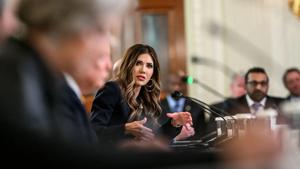
Markwayne Mullin, secretary for the U.S. Department of Homeland Security, defended the agency’s $118.3 billion budget request Tuesday.
Mullin, a former U.S. Senator from Oklahoma, testified before the Senate Appropriations subcommittee on Homeland Security on the department’s fiscal year 2027 request, which is a 5.7% increase from the appropriations for fiscal year 2026.
The department’s request comes after the longest government shutdown in history. DHS was shut down for 76 days due to division in Congress over funding for Immigration and Customs Enforcement and Customs and Border Patrol.
Sen. Chris Murphy, D-Conn., slammed Mullin over the agency’s immigration enforcement actions. He said the agency has deported people who have not broken the country’s immigration laws and misused taxpayer dollars.
He pointed to reports that private prison groups marked up the price of several detention facilities by as much as 1,000 times its originally assessed value. The facilities were later sold to DHS at the marked-up value, according to the reports.
“You must stop patting the pockets of immigration industry CEOs. You must rein in this out of control over spending,” Murphy said. “This agency is violating the Constitution and the law.”
Mullin said Murphy’s rhetoric about DHS has led to increased assaults against federal officers seeking to enforce immigration laws. He defended the Trump administration’s immigration enforcement measures and called for greater cooperation between local leaders.
“There’s a reason why people are flooding to our country and not flooding to leave, and it’s our job to protect the homeland, and we do that every single day,” Mullin said. “If ICE can’t do their job, then who is supposed to get the illegals out?”
The budget for DHS maintained funding for Immigration and Customs Enforcement at $10 billion, the same as fiscal year 2026. The request included notable reductions for Customs and Border Protection, Transportation Security Administration and the Federal Emergency Management Agency.
Mullin requested $6.1 billion for the TSA, compared to fiscal year 2026 with $7.6 billion.
Sen. Katie Britt, R-Ala., said the funding priorities appear to favor partnerships with private companies, rather than continuing the function of TSA in its current role. She appeared to express concern over the agency’s drawdown in funding.
“It seems as though TSA is moving in a direction that might culminate years down the line as more of a coordinator or a regulator of security rather than performing security screening functions themselves,” Britt said.
Mullin explained private industry moves faster than government regulation can keep up. He said allowing more private investment in airport security screening will make for a faster process that is mostly immune to government shutdowns.
“Let’s partner with the private industry with some of the best technology to move us to the gold standard of traveling moving down the road,” Mullin said.
The department’s budget also calls for a decrease in funding for the Federal Emergency Management Agency. The department requested $4.1 billion, compared to $4.7 billion that was appropriated in fiscal year 2026.
Sen. Cindy Hyde-Smith, R-Miss., praised Mullin for the department’s move to reduce appropriated funds. She said she is concerned about the planned reduction in matching funds between DHS and state agencies when responding to disasters.
“We have a lot of hurricanes, we have a lot of tornadoes there and it’s just been considerable discussion regarding potential changes to these thresholds,” Hyde-Smith said.
Mullin said FEMA was designed as an assistance tool, not a primary funding mechanism for communities impacted by natural disasters. He said matching grants will likely be reduced in the future in order to give state and local governments greater authority to manage natural disaster response.
“We know that states can do it much quicker, much faster, and much cheaper than we can as the federal government,” Mullin said.
Sen. Jeanne Shaheen, D-N.H., said she is concerned about students studying on visas at a university in New Hampshire. She said several policies by the department would revoke their visas by July 1.
“They’re going to potentially lose 2,000 students, graduate students,” Shaheen said. “It’s very important to the community in which it is and also very important to the State of New Hampshire.”
Mullin said he would provide Shaheen with an update “later” on the visas but did not have immediate news to share.
Senate appropriators will deliberate over the department’s budget request and approve or add amendments to by Sept. 30, the final day of fiscal year 2026.





Showers And Thunderstorms Likely
Latest News Stories

Americans prepare to spend $1 trillion this holiday shopping season

Illinois quick hits: Migrant youth allegedly murdered homeless Chicago man

WATCH: Trump calls Pritzker a ‘fat slob,’ Illinois governor blasts president
Illinois business group warns of ‘backbreaking’ progressive income tax

Illinois tops U.S. in pumpkin production despite recent decline in value
Congress moves to restore federal union powers, critics warn of higher costs
Ukraine agrees to preliminary peace plan; Russian strikes continue

Illinois quick hits: Chiropractor sentenced for fraud; fatal airport shooting investigation
Trump administration ends protected status for Burmese nationals
Lincoln-Way 210 Receives Clean Audit, Financial Profile Score Downgraded to ‘Review’

Committee Grants Lenox Solar Farm Project Six-Month Variance Extension
Trump designates Muslim Brotherhood as foreign terrorist organization