Michigan township denies solar expansion after months of controversy
After months of public opposition, a southwest Michigan township has voted to deny an expansion for a utility-scale solar project.
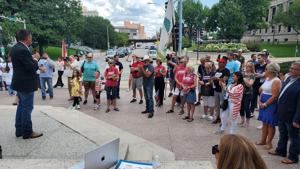
The Fayette Township Planning Commission voted Monday night to deny a special land use permit sought by Ranger Power, receiving a standing ovation from the community members filling the Jonesville High School auditorium for the vote.
“It was important in so many ways,” Fayette Township resident Stephen Oleszkowicz, who helped organize opposition to the project, told The Center Square. “It helped unite support for the Planning Commission instead of pitting the residents against them. It sent a clear message to the applicant: ‘We are done.’”
Ranger Power, which currently runs Heartwood Solar I, was hoping Heartwood Solar II and Heartwood Solar III would be approved to expand solar development onto hundreds more acres of farmland across Hillsdale County. If approved, the township could have seen had than 20% of its 13,000 acres wrapped up in the project.
The township’s denial follows months of contentious public meetings that drew opposition from hundreds of residents and local elected officials.
“It does not satisfy the provisions,” the commission stated in its motion to deny on Monday night.
One of those provisions for denial included “vast use of farmland converted to industrial solar,” among many others.
The planning commission’s decision was influenced in part by its recent adoption of a Compatible Renewable Energy Ordinance, which established local zoning standards for renewable energy developments in the township. That CREO was adopted as part of the effort to prevent the expansion.
Despite the township’s rejection of the permit, Ranger Power could still appeal the decision to the Michigan Public Service Commission for an override.
Under Public Act 233, approved by state lawmakers in 2023, developers of large renewable energy projects can seek approval from the commission if local approval is denied or local ordinances are deemed overly restrictive.
Oleszkowicz said he expects Ranger Power to continue pursuing the project.
“In my opinion, Ranger has three options: quit, sue, or file with the MPSC,” he said. “They aren’t going to quit. They have too much money tied up in it already … this fight isn’t over.”
Oleszkowicz pointed to other Michigan solar projects where the company has either challenged local decisions in court or sought approval directly from the commission.
The state commission’s intervention has become a focus in Michigan’s broader debate over renewable energy development, as extensively reported on by The Center Square in an exclusive series on solar in Michigan.
Supporters of Public Act 233 say the law is necessary to ensure enough renewable energy projects are built to meet the state’s Democrat-passed clean energy mandates, which requires utilities to generate 80% of their electricity from clean sources by 2035 and 100% clean energy by 2040. Critics argue the law overrides local control in favor of developers.
Oleszkowicz said he plans to continue making the township’s case against the project, even if it reaches the state commission.
“While many of the stipulations for denial could be overcome by the applicant, there is not a single sane person that can stand in front of the public and state that 26.2% of a farming community locked out of farming and converted to industrial-scale solar is reasonable,” he said. “The MPSC has a duty to take that farm land and farm economy into account.”
Oleszkowicz pointed to a recent recommendation by commission staff to deny a solar proposal in Washtenaw County as evidence that state regulators, despite largely siding with developers, may be willing to scrutinize large projects like Heartwood Solar.
For Oleszkowicz, he explained that continuing to stand against the project isn’t optional.
“I don’t think I have a choice but to be involved,” he said. “The community has been looking to me for guidance and information, and I will continue to do just that.”
As this issue grows across the state and nation, Oleszkowicz encouraged residents in other communities facing similar proposals to engage early in the process.
“Study, research, connect with neighbors, take action early, and reach out to other communities that are further down this rabbit hole,” Oleszkowicz said. “Regardless of the outcome, I will walk away an involved citizen. I will walk away with more friends than I had before. I will walk away knowing that I did everything in my ability to protect this community, not only for my family but also for those who can’t fight for it themselves.”



Showers And Thunderstorms Likely then Mostly Cloudy
Latest News Stories

Chinese national indicted in COVID-era hacking scheme extradited to Texas

Illinois Quick Hits: $60M sports complex opens in Springfield

Florida House panel approves new congressional district map
Green Beret pleads not guilty to betting on his own mission
Cook County Judge Lyke’s decisions allowed accused cop killer to be free

Congress urged to defund abortion in wake of Planned Parenthood $90M COVID loan revelation
Madigan’s next option the U.S. Supreme Court

Congressional progressives introduce $25 federal minimum wage plan

Illinois Quick Hits: Gas prices rise again

Illinois Senate to consider megaprojects after Pritzker calls out amusement tax
EXCLUSIVE: SPLC called on to remove parental rights groups from its ‘hate map’

Illinois Quick Hits: Driver killed in reported shootout with police on I-88