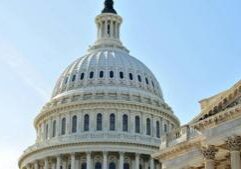
Researchers put a number on how much debt U.S. can carry
The United States has about 20 years to change course on its national debt before it reaches the estimated limits of its debt capacity, according to new research from the Penn Wharton Budget Model.
Researchers estimate the outer limit of U.S. debt capacity at about 210% of gross domestic product. At that point, even a 100% tax on labor income would not generate enough revenue to cover interest costs, making the debt impossible to stabilize through labor-tax increases alone.
Waiting until that threshold is reached would carry a steep cost. According to the model, stabilizing the debt at that point would require a permanent increase of about 15 percentage points in taxes on all labor income, more than Americans currently pay toward Social Security and Medicare Part A combined.
Federal debt held by the public equals about 101% of GDP. The federal government is projected to spend more than $1 trillion servicing that debt in fiscal year 2026, more than it spends on discretionary defense. The Congressional Budget Office projects debt will climb to 175% of GDP by 2056 under existing law.
The 2025 reconciliation act, known as the One, Big, Beautiful Bill Act, added an estimated $4.7 trillion to projected deficits over the coming decade, according to the Congressional Budget Office, further increasing the debt burden.
How quickly the nation approaches its debt limit depends largely on the growth of federal health care spending. Under assumptions consistent with the CBO’s baseline projections, the debt limit would be reached around 2051. Under a scenario with historically higher health care cost growth, the deadline moves up to 2045. In that case, Penn Wharton researchers estimate a 25% chance the limit could be reached within 14 years.
Financial challenges could emerge before the government reaches the model’s theoretical ceiling.
Darrell Duffie, a Stanford finance professor who studies the Treasury market, said investor confidence could erode before debt reaches its estimated maximum. He noted that foreign central banks and other reliable buyers are unlikely to absorb much more U.S. debt, leaving a growing share in the hands of discretionary investors such as hedge funds and mutual funds whose appetite for Treasuries is less predictable.
“The vulnerability of market functioning to the increasing quantity of Treasuries held by discretionary investors just keeps growing with the total supply of Treasuries,” Duffie told The Center Square.
Will McBride, chief economist at the Tax Foundation, said he sees signs of that pressure already building. He cited interest rates rising above what CBO projected, decreased foreign government ownership of U.S. debt, credit downgrades by all three major rating agencies over the past 15 years, and inflation reaching a 40-year high after the federal government sharply increased borrowing during the pandemic.
“The debt trajectory is unsustainable and tax-only solutions would require unprecedented tax hikes that would create large economic distortions and slow economic growth,” McBride told The Center Square.
The Penn Wharton analysis assumes investors continue to believe Congress and the president will eventually take steps to stabilize the nation’s finances. The model’s “required closure year” represents the latest point at which policymakers could still enact a feasible solution. Acting earlier would result in significantly lower costs.
Kent Smetters, the Penn Wharton Budget Model’s faculty director and the report’s lead author, said the risk of an earlier crisis is real but impossible to time precisely.
“As soon as capital markets start believing that Congress will never get its act together, things unravel immediately,” Smetters told The Center Square. “It’s no different than a bank run problem: a solvent bank can become insolvent simply because people believe it is insolvent.”
The Treasury Department did not respond to requests for comment before deadline.
The federal government has not recorded a budget surplus since 2001. The federal deficit has exceeded 3% of GDP every year since 2015. Treasury Secretary Scott Bessent warned lawmakers last year that the nation’s debt path is “unsustainable when and if the markets were to rebel.”
Sen. Steve Daines, R-Mont., echoed those concerns at an American Enterprise Institute panel discussion Wednesday on the national debt.
“We’re running a very dangerous experiment here in the United States,” Daines said. “We’re living on borrowed time because we got a heap of borrowed money.”
Daines added that he is concerned Congress “lacks the will to ever do anything” to address the problem.
The Penn Wharton researchers estimate that under current trends, policymakers have about two decades to implement fiscal changes before the available options become significantly more costly and potentially insufficient to stabilize the nation’s finances.






Areas Of Drizzle
Latest News Stories

Campaign begins highlighting NYC nonprofit hospital’s prioritizing ‘woke’ ideology
Pro life org asks Senate for another bill to keep abortion defunded of tax dollars
Oklahoma Senate primary kicks off race to succeed Mullin

Supreme Court to hear immigrant detention case

Poll: Most voters oppose mid-decade redistricting

Illinois Quick Hits: 26 tornadoes confirmed in Illinois, NW Indiana last week

Trump visits European leaders after Iran peace deal announcement
Alabama to choose candidates for Tuberville’s open Senate seat

No friends for Comey; judge rules no amicus briefs

Everyday Economics: Working more, falling behind

America 250: Celebrating presidential pets

Census Bureau plans 2030 count as 2020 lawsuit continues