Trump throws another curveball at FISA Section 702 reauthorization
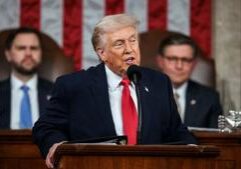
President Donald Trump has once again complicated Republican leadership’s plans in Congress, demanding Monday that lawmakers attach voter ID legislation to the spy powers reauthorization bill.
House lawmakers failed to even pass a short-term extension of Section 702 of the Foreign Intelligence Surveillance Act before recessing Friday, hours before the president offered a belated olive branch to Democrats.
FISA Section 702 allows the federal government to conduct warrantless data surveillance on foreign nationals of concern, although Americans’ data is often collected and subject to warrantless searches as well.
Democrats’ almost universal opposition to the FISA Section 702 extension stemmed from Trump’s controversial appointment of Bill Pulte as the new acting director of National Intelligence.
Had Trump announced his nomination of Jay Clayton, the broadly respected former U.S. Securities and Exchange Commission chairman, to be the next DNI prior to the Friday vote, the extension might have passed.
Yet even as Republican leaders scrambled to schedule a confirmation hearing for Clayton and restart negotiations with Democrats over the now-expired Section 702, Trump threw another curveball Monday.
In a Truth Social post, the president announced that he would be “against FISA if it doesn’t come with The Save America Act (Full version!) firmly attached to it.”
The demand is politically impossible for Republicans, who don’t have enough votes in the Senate for the House-passed legislation to overcome the 60-vote threshold.
The SAVE America Act would mandate that Americans display a valid ID to vote in federal elections, require people to present proof of citizenship when registering to vote, and necessitate in-person voter registration for federal elections. It also directs all states to remove all noncitizens from their voter rolls.
Under the legislation, people would not be able to register to vote with only their driver’s license, since noncitizens can obtain that. They would instead need to present documents proving U.S. citizenship, such as a birth certificate or U.S. passport.
Democrats argue that the in-person registration and proof of citizenship requirements would unduly burden Americans who are disabled, live in remote areas, or don’t have access to the correct documentation.
The House-passed SAVE America Act, which would strengthen voter identification requirements nationwide, faltered and effectively died in the Senate after it became clear that every Democratic senator would oppose it.
Though a handful of Republican senators are calling for a termination of the filibuster, Sen. John Cornyn, R-Texas, echoed the sentiments of Republican leadership in a social media post – “Not gonna happen, and every one (except the naive or misinformed) knows it.”
Leadership will likely ignore Trump’s demand, given that a FISA Section 702 extension is definitively doomed if the SAVE America Act is attached. Since the House does not return from recess until June 22, Section 702 won’t be renewed until next week at the earliest.
In the meantime, Clayton will appear Wednesday before the Senate Intelligence Committee, though he likely won’t be confirmed until late next week.



Partly Sunny
Latest News Stories

Watchdog says healthcare providers may be misrepresenting child gender treatments as routine care

Everyday Economics: Inflation squeezes household spending

Hurricane season month away; forecast modest

Pentagon seeks $21B for barracks as repair backlog doubles

Lincoln-Way Updates Student Handbook, Bans “Smart Glasses” to Combat AI Cheating

Meeting Summary and Briefs: Village of Manhattan for April 21, 2026

Will County Board Approves Tax Abatement Intent for “Project North Winds” Manufacturing Facility

Lincoln-Way West Softball Capitalizes on Errors to Shut Out Lincoln-Way Central 11-0

Illinois lawmaker warns medical records bill could delay care

‘Farm Bill’ may ease cost burden for farmers; Ag groups urge US Senate action
Indiana voters to decide compeititive congressional primary races Tuesday

U.S. debt tops 100% of GDP, ‘deeply troubling’ for economy, national security