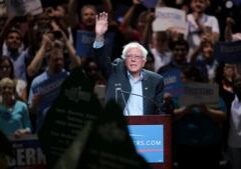
Sanders bill would give U.S. stake in AI companies; analyst calls idea ‘nutty’
A U.S. Senate bill would give the federal government a 50% ownership stake in the largest artificial intelligence companies, creating a sovereign wealth fund its sponsor estimates would be worth $7 trillion. One policy analyst called the idea “nutty” while others said it would put American AI companies at a combative disadvantage and would lead to offshoring.
Sen. Bernie Sanders, I-Vt., introduced the American AI Sovereign Wealth Fund Act, which would impose a one-time 50% tax on AI company stock and deposit those shares into a fund that could pay every American more than $1,000 annually.
Sanders said AI was built on “the collective knowledge of humanity and the creative work of tens of millions of people” and that the public deserves a direct ownership stake in the companies that have profited from it.
The fund would be managed by a seven-member independent commission, nominated by the president and confirmed by the Senate, with authority to use its voting shares to block corporate decisions it determines hurt the American people.
The bill would also require large companies that operate both AI and non-AI businesses to separate those operations, with the public receiving an ownership stake in the AI side.
The bill would apply to AI companies with at least $200 million in annual revenue, and any new company that reaches that threshold would also be subject to the stock transfer. OpenAI, Anthropic, Meta and Google each reported well over $200 million in AI-related revenue in 2025, according to public financial reports and company statements.
The largest AI companies named in the legislation did not respond to questions about how the bill would affect their operations by deadline.
The bill had not been assigned a number or referred to committee as of Friday afternoon. No cosponsors were listed.
Sanders said his proposal goes further than what President Donald Trump or AI company executives have suggested, describing their approach as offering “5% of our profits back into the government” rather than direct public ownership.
Trump said June 5 that a government stake in AI firms could be “a partnership with the American public” and that his administration would “look into” the concept.
Trump signed an executive order in February 2025 directing his administration to develop a plan for a sovereign wealth fund, though no fund has been established.
OpenAI proposed in its April policy paper “Industrial Policy for the Intelligence Age” a public wealth fund that would provide every citizen “a stake in AI-driven economic growth.” Anthropic CEO Dario Amodei wrote recently that universal basic income “could be financed through taxes on relevant companies.”
Elon Musk, owner of xAI, said in an April post on X that “universal HIGH INCOME via checks issued by the Federal government is the best way to deal with unemployment caused by AI.”
Sanders estimates the fund would be worth about $7 trillion at current valuations. A 5% annual dividend could generate direct payments of more than $1,000 to every American – about $1,045 per person, based on 5% of the estimated $7 trillion fund divided by the current U.S. population – with additional gains directed toward health care, education and housing. If AI company valuations decline, Sanders said, the companies would bear the losses, not the federal government.
Sanders said the bill would ensure AI wealth benefits the public rather than shareholders.
Senate Banking Committee Chairman Tim Scott, R-S.C., said in opening remarks at a June 11 Banking Committee hearing on AI that the committee’s primary objectives are “protecting consumers and American workers, supporting domestic innovation, and ensuring that AI technology is developed by American companies with American values rather than ceding leadership to China.”
Scott’s office and Senate Commerce Committee Chairman Ted Cruz, R-Texas, did not respond to requests for comment by deadline.
Tad DeHaven, a Cato Institute policy analyst who studies government taxation and spending, wrote this month that Sanders “wants political control” over AI companies through voting shares and board representation, and warned that Trump’s own pursuit of government equity stakes in private companies had “opened the door” for the Sanders proposal.
Phillip Magness, an Independent Institute economist who studies taxation and capital markets, said the one-time stock transfer carries its own capital flight risks.
“Since the tech industry tends to be highly mobile and under intense competition from abroad, a tax of this type could trigger offshoring to reduce the tax burden, or could place AI companies that remain in the U.S. at a competitive disadvantage against the rest of the world,” he told The Center Square.
“Legislators seeking to justify new and expansive forms of taxation almost always overestimate their ability to raise revenue,” he said. “Sanders is likely basing his AI company tax proposal on current market valuations, which would also be adversely affected by the implementation of the same measure.”
Bruce Schneier, a Harvard fellow and security technologist who has written extensively on AI policy and technology governance, called the approach “absolutely nutty,” saying the bill would not achieve Sanders’ goal of democratic control over AI development.
“Control will be maintained by the tech oligarchs,” Schneier told The Center Square. “The only difference is that the government will now have a conflict of interest when it comes time to regulate them.”
Schneier said the better approach is to tax AI companies directly to return profits to the public, and separately create a government-run public AI option that operates outside the for-profit market.
“Let government do what it does best, and create a thing that lives outside of the for-profit market system,” he told The Center Square. “The goal here isn’t to replace corporate AI, but to provide an alternative.”
California Gov. Gavin Newsom signed Executive Order N-6-26 in May directing state agencies to evaluate policies to address AI-related job losses, including whether residents should receive direct ownership stakes in companies or funds generating AI-driven income.




Mostly Sunny
Latest News Stories

WATCH: Homan targets Chicago; Freedom Caucus responds to Pritzker’s ‘move out’ comment

Everyday Economics: Why weak jobs data trumps inflation concerns for Fed policy

EXCLUSIVE: Secret Service spent $11 million on Hunter Biden travel detail

Proposed federal funding bill doles out nearly $16M for electric, hydrogen buses

WATCH: Democrats ‘hate’ Trump more than they ‘love’ their communities, Homan says

Bipartisan group of lawmakers aim to increase migrant physician jobs
WATCH: Border czar Homan considered turning Trump’s offer down
WATCH: DeSantis addresses State Freedom Caucus Foundation

Higher ed spending up as enrollment plummets at Illinois universities

World’s largest retailer struggles to keep costs down as tariffs hit

Northwestern president steps down amid federal funding cuts
Push to ban stock trading by Congress follows IL rep’s reported violations