
Federalist Society panel takes on third-party lawsuit financing
The pros and cons of the multibillion-dollar financing industry that has ignited the growth of mass tort litigation was the focus of debate at The Federalist Society yesterday.
The conservative legal group hosted a panel titled, “Litigation Finance: Access to Justice, Lawfare, and Foreign Influence,” which featured three experts on the growing practice by hedge funds and investment firms to finance mass tort lawsuits. The practice has drawn the attention of state and federal lawmakers, with North Carolina recently banning it outright.
“Third-party litigation finance basically boils down to this concept that the law firms bringing cases… have started going out and finding non-lawyers to fund their lawsuits,” explained Oramel Skinner, III, executive director at the Alliance For Consumers.
The firms enter into “various kinds of complicated financial arrangements that range from traditional loans to secured loans to… hybrid funding that allows the funder to have substantial upside in some of the cases that has, in turn, attracted huge funds, whether it’s Fortress Investments or Burford Capital or others, that are attracting large amounts of money and in some instances from… sovereign wealth funds abroad.”
Historically, U.S. courts prohibited the funding of lawsuits by persons who are not parties to the legal action, a practice known as champerty. But within the last two decades, third-party litigation funding, or TPLF, has exploded and become a regular and accepted practice for financing large-scale mass tort litigation in state and federal courts.
And it’s become big business. “Right now, there’s about $16 to $19 billion” invested in U.S. litigation by the major litigation funders, according to Phil Goldberg, co-chair of Shook, Hardy & Bacon’s Public Policy Practice Group. “The number’s probably a lot higher since that’s largely… self-reporting,” Goldberg added.
Proponents of TPLF argue that the practice increases access to courts for those who can’t afford the high costs of litigation and whose cases may not attract more traditional types of financing like contingency-based lawyer fees.
“Litigation finance can be a great equalizer, and particularly for people who are conservatives, particularly for people who are kind of mainstream Americans, who don’t have the resources to litigate a case on their own,” argued Gene Hamilton, president of America First Legal Foundation. TPLF “can actually help somebody have their day in court that they might not otherwise be able to do because they don’t have the funding to finance” a lawsuit.
The dramatically rapid increase in litigation funding, however, has raised a number of serious concerns about the practice and its impact on the court system and the litigants involved in the cases funded. The U.S. Chamber Institute for Legal Reform has detailed significant impacts to the judicial system, namely that TPLF allows foreign interests to exert destructive influence in the U.S. economy, limits the ability of litigants to control their own cases by placing the funder in control of important litigation decisions and diverts an undue amount of monetary awards to the funder and not the party actually involved in the case.
That was the experience of Santo Sanchez Fuentes, whose case Legal Newsline reported on previously. His personal injury suit settled for $3.75 million. The third-party funder took almost $1.8 million, and Sanchez was left with less than half-a-million dollars from the total judgment.
“What we’ve seen is going from zero to 60 with absolutely no rules of the road,” Goldberg described. “Nothing to protect plaintiffs from funders and their lawyers who are beholden to the funders and not to them. Nothing to protect courts… from being influenced by these outside funders and nothing to protect the defendants from when they settle with a plaintiff to then have to continue litigation because the funder says, no, that settlement isn’t high enough,” Goldberg continued.
This increasing flow of money into the mass tort industry has also had the effect of generating more and more litigation. “As you see the increase in litigation funding,” Goldberg said, “you see the increase in… advertising” by lawyers. Goldberg cited a 2024 report by the American Tort Reform Association pegging lawyer ad spending at $2.5 billion, a 32% increase over 2020. “It’s been termed the vendorization of mass torts,” Golberg added.
Ultimately, the proliferation in funding and case generation acts as a tax on the U.S. economy, critics say. According to a December 2025 report published by Citizens Against Lawsuit Abuse, third-party litigation funding costs American consumers $192.79 per person and $607.27 per household.
Growing concerns surrounding litigation funding has led a number of states to pass legislation regulating TPLF arrangements. Wisconsin, Indiana, Montana, West Virginia, Kansas, Georgia, Oklahoma, and Louisiana all have enacted requirements that litigants disclose any litigation funding arrangements. Earlier this spring, Louisiana introduced a bill that would limit the amount funders can be paid to the total amount the plaintiff recovers after paying all attorneys’ fees and other costs.
Federal attempts to lessen the impact of TPLF have not been as successful, however. Last year, Senate Republicans introduced a bill that would more than double the tax rate applicable to proceeds earned by litigation funders and would apply to foreign investors, and earlier this year a group of Senate Republicans proposed a measure that would require disclosure of litigation funding and limit the ability of funders to influence litigation or settlement decisions. Neither bills have passed.
But not everyone agrees that these reforms are a positive development. “When I look at litigation finance, I see an immense amount of effort being taken by corporate America and big law firms on something that has just a bunch of flaws that I think are actually causing real problems. The litigation finance reform effort is causing the problems,” Skinner argued.
“So, for starters, at the end of the day, it begins with this very concerning notion that I need to know who’s behind the lawsuit, and then who’s behind them, and then who’s behind them, and then who’s behind them, right? It feels like Sheldon Whitehouse,” Skinner said, referring to the U.S. Senator from Rhode Island who is a leading proponent of forcing nonprofit organizations to disclose their donors.
Hamilton was of a similar mind, arguing that litigation funding disclosure requirements are ill-suited to stem the rising tide of frivolous litigation. “We need to have some fixes. We need to prevent frivolous cases from filling up our court dockets. We need to address the incentives that allow for… mass tort litigation to go on where attorneys don’t even meet their clients,” Hamilton said. “Let’s solve those discrete problems. But… what I see here,” referring to laws regulating TPLF, “is this kind of overbroad attempt by industry.”
Whether that means there shouldn’t be any regulation of litigation funding at all is the ultimate question and, to proponents of TPLF regulation, doesn’t seem like the right answer given the real-life problems the financing practice creates.
“Yeah, but the idea that there’s no problem here to solve, I think, is not the right one because we’re seeing so many abuses of the system,” Goldberg said. “Because there’s no disclosure, because it’s not regulated, we’re just seeing the tip of the iceberg because we don’t see what abuses are happening where we haven’t… had any disclosure.”






Mostly Sunny
Latest News Stories

Data center regs proposed as $20 billion, 795-acre Joliet project advances

Labor stats offer mixed bag for Illinois

Lawsuit: IL state VRA unconstitutionally lets Dems divide voters by race

Illinois Quick Hits: State grants offered to tackle ‘challenging’ properties

Officers mourn fallen Chicago cop as policy debate grows
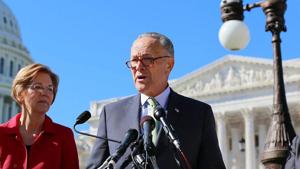
Trump accuses Schumer of election ‘interference’ with New York task force
Poll site gun ban proposal draws pushback

Trump confirms gas tax suspension push as prices hit $4.52

Trump says Iranian ceasefire on ‘life support’
Meeting Summary and Briefs: Will County Board Finance Committee for May 5, 2026
Committee Advances Nearly $212,000 in Road and Facility Contracts for Jackson Township and Monee
Will County Committee Hits Brakes on License Plate Reader Agreements Awaiting Privacy Policy Review