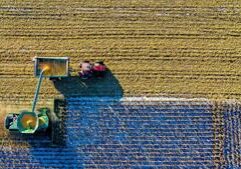
Flooding, weather events impact farmers, taxpayers
(The Center Square) – Federal and state government agencies have announced assistance plans for farmers impacted by severe weather and flooding, but some producers may not want help.
The U.S. Department of Agriculture said on June 26 that agricultural operations in Illinois have been significantly impacted by severe weather and tornadoes.
The agency said technical and financial assistance is available to help farmers recover.
“Crop insurance and other USDA risk management options are offered to help producers manage risk, because we never know what nature has in store for the future,” said Mitchell Zipprich, Director of USDA’s Risk Management Agency Regional Office that covers Illinois.
On Thursday, state officials announced disaster tax relief in 11 counties covered by Gov. J.B. Pritzker’s recent disaster proclamation.
Taxpayers in the impacted counties may request a waiver of penalties and interest if severe weather prevents them from filing tax returns or making payments on time.
Dave Stark is president of agriculture at Holganix, a regenerative agriculture company.
Stark said many farmers don’t want government money.
“They would rather do it on their own. But farming is, as you just said, you never know. Is there a normal year anymore? What’s normal? And that’s been true my whole 43-year career in agriculture. That’s always been a wild card, the weather,” Stark told The Center Square.
Dan Meyer planted his 40th crop this year near Tuscola in Douglas County.
“We’ve had to change. We had places in our fields for both corn and soybeans that flooded out, where the water just stood for so long that, eventually, the crops drowned out,” Meyer told The Center Square.
Meyer said his son planted about 100 acres of soybeans in April but didn’t get back into the field for almost a month because of rain.
Then, after crops were planted in May, parts of Illinois had record rainfall in June.
“On Friday, July 3rd, I went back out and planted five flooded-out areas once more with an old tractor and small planter of soybeans. It’s really too late to try and plant any corn now,” Meyer said.
Meyer said he could still have a decent crop if the weather is agreeable in July and August.
“But if we would hit a drought period or something like that, it could be pretty tough on the overall yields,” Meyer said.
Stark said Illinois is blessed with some of the best corn ground on Earth, but corn is more susceptible than soybeans to weather and erosion.




Sunny
Latest News Stories
Report: Sharp ideological divide in Minnesota congressional delegation

White House correspondents’ dinner shooter faces formal charges
Deferred maintenance blamed in I-64 bridge hole

Supreme Court strikes down Texas redistricting lawsuit, upholds new maps
Supreme Court to hear migrant farm worker case

Illinois quick hits: Convicted felon suspected of shooting two officers; Chicago Mayor orders up to $900,000 for additional peacekeepers; Belleville man faces attempted murder charge
Lincoln-Way D210 Approves $483,000 Agreement with Illinois Bone and Joint Institute, Adds Seventh Athletic Trainer
Manhattan Fire Board Reviews Financials, Navigates ‘No Tax on Overtime’ Law

Pitching Duo Dominates as Lincoln-Way West Baseball Edges Oak Forest 4-2

Will County Passes Comprehensive Adult Entertainment Ordinance
Manhattan Village Board Unanimously Adopts $32.7 Million Budget for Fiscal Year 2027

Correspondents’ dinner attacker detained with multiple weapons