WATCH: Supreme Court ruling next year could reshape transgender rights beyond sports
In seven weeks, the U.S. Supreme Court will hear oral arguments in two cases involving challenges to the constitutionality of laws in Idaho and West Virginia that prohibit transgender women and girls from participating on women’s and girls’ sports teams. A decision in these cases could have far-reaching implications nationwide.
On Jan. 13, 2026, the nation’s highest court will review lower court decisions in favor of transgender athletes from Idaho (Little v. Hecox) and West Virginia (West Virginia v. B.P.J.) who challenged the bans in their respective states. The Idaho case involves the 14th Amendment’s Equal Protection Clause. The dispute over West Virginia’s law involves the Constitution’s guarantee of equal protection and Title IX, the landmark civil rights law that prohibits sex-based discrimination in education.
Beth Parlato is the senior legal advisor at the Independent Women’s Law Center, which is a project of the Washington, D.C.-based Independent Women’s Forum.
According to her, a broad ruling by the Supreme Court could have nationwide implications.
“The broad ruling, what that would do, is clarify what the definition of sex means. That it’s biologically male and female and that it’s immutable, and that specifically it does not mean gender identity,” Parlato explained. “So, we are hopeful that the court is going to give us a broad ruling to clarify the meaning of sex.
“What that means is that girls will be protected in all 50 states. So those 24 states that do not have legislation that protect girls’ sports, they will now be under this Supreme Court [order] and that’s all the girls in the United States [who] will be protected, including those in your state of Washington.”
Parlato acknowledges that the court could issue a narrower ruling that doesn’t impact other states.
“That would be bad news for the blue states, because it doesn’t really do anything for girls in those states,” she said. “So, we are remaining very hopeful that we’re getting a broad ruling that’s going to clarify the definition of sex, and that dividing athletics by sex, and sex segregated sports, is what rightfully is supposed to happen under Title IX. And it’s legal and constitutional to have sex separated sports.”
Current Washington state policy allows transgender students to participate in sports programs consistent with their gender identity.
But the issue has become increasingly political on both sides of the aisle recently, especially now, in light of President Donald Trump’s Feb. 5 executive order, “Keeping Men out of Women’s Sports.”
The Center Square reached out to the Washington Office of Superintendent of Public Instruction for comment on the pending cases before the Supreme Court.
“OSPI will continue to uphold and enforce our state law unless or until the law changes,” OSPI Chief Communications Officer Katy Payne said in an email to The Center Square.
Let’s Go Washington, the political action group behind IL26-638, to “require students to undergo a routine physical examination prior to participation in interscholastic sports,” sent a statement via text to The Center Square on Monday.
“We respect and appreciate the efforts being made by IWF,” LGW found Brian Heywood wrote. “Fairness in girls’ sports is under attack at the federal, state and local level, and it is critical that we fight back on all fronts against an ideology that is unfair and unsafe for girls. We believe the national tide is turning and the policy of allowing boys in girls’ sports should and will be thrown out with the appropriate derision it deserves.”
A ruling in the cases is not expected until late spring.
“So, when we get this from the Supreme Court … it has implications well beyond just athletics, and this can now go into all the other areas that we have been working on,” said Parlato. “It’s unbelievably great for athletics to keep girls’ sports for girls, not only for fairness, but really for safety.
“But then let’s look at the locker rooms and showers and all-girl sororities and all-female prisons and the other areas where females deserve private spaces. We need the Supreme Court to clarify that sex is male and female, and it does not include gender identity. This will then stop the males from trying to continue to enter into female spaces. This would be a huge generational win for us, and we’re looking forward to it.”
Community Events
Latest News Stories
Will County Eyes Major Overhaul to Consolidate Scattered Government Offices
Sheriff’s Office Reports Crime Down 10%, Cites Body Cam Footage as Main Challenge of Safety Act
Will County Considers Moving Land Use Public Hearings Away from Full Board Meetings
Meeting Summary and Briefs: Jackson Township Board for August 13, 2025
Jackson Township to Investigate Decade-Old High-Speed Rail Plan Through Elwood
Meeting Summary and Briefs: Manhattan Park Board for August 14, 2025
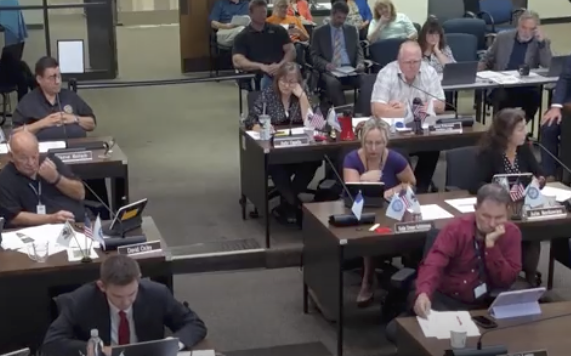
Meeting Summary and Briefs: Will County Board for September 18, 2025
Jackson Township Approves Settlement with Joliet, Union Pacific Over ICC Case
Meeting Summary and Briefs: Lincoln-Way Community High School District 210 Board of Education for September 18, 2025
Manhattan Park Board Deadlocks on Paying for Sports Complex Plan, Motion Fails

Manhattan-Elwood Library Board Adopts Annual Budget and Appropriation Ordinance
Lincoln-Way 210 to Launch District Literacy Plan, Expands Community Partnerships