Twenty years later, Katrina still among Atlantic’s most deadly, costly
Twenty years ago this Friday, Hurricane Katrina – once a Category 5 beast – made landfall as a Category 3 first in southeastern Louisiana and then again on the Mississippi Gulf Coast.
The National Hurricane Center, an arm of the National Oceanic and Atmospheric Administration, calls Katrina “one of the most devastating natural disasters in United States history.” More than 1 million were displaced, the death toll has fluctuated between 1,833 and 1,392, and the damage estimate was $125 billion.
In today’s dollars, it would be $226 billion.
“Katrina was an extraordinarily powerful and deadly hurricane that carved a wide swath of catastrophic damage and inflicted large loss of life,” the report from the Hurricane Center says. “It was the costliest and one of the five deadliest hurricanes to ever strike the United States.”
Arguments persist on storms, including the volume and the intensity. In the 20 years since, varying reasons have led to some of the worst from the Atlantic basin and its season that runs June 1 to Nov. 30.
Patterns suggest if and where the storms strike outweigh storm intensity at landfall. A look back only to Hurricane Helene last fall shows that while the storm was Category 4 at landfall in Florida, it was while over the mountains of North Carolina that the greatest loss of life and property damage came.
Helene is recorded as 250 deaths (176 direct) and $78.7 billion in damage in the report issued in April from the Hurricane Center. In North Carolina, 107 deaths and $60 billion are attributed to the storm.
One that didn’t strike the mainland but is high on American lists is Hurricane Maria in 2017. It devastated the American territory of Puerto Rico, with more than 3,000 deaths and $91.6 billion in damage.
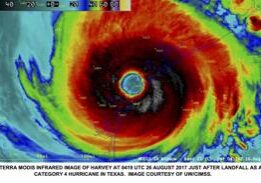
On the mainland that year, Hurricane Harvey killed 103 – 68 were deemed direct from the storm, the Hurricane Center says – and caused $125 billion in damage. In today’s dollars, that’s $164 billion.
Harvey reached Category 4 status on the wind scale, yet it was the 60 inches of rainfall over four days in southeastern Texas that caused flooding and the most direct deaths.
Ian in late September 2022 killed 156 (66 direct) and caused an estimated $112.9 billion in damage, striking the southwestern tip of Florida at Cayo Costa Island. It crossed back to the Atlantic through Cape Canaveral, and went north into Georgetown, S.C.
Statistically and geographically different, Hurricane Sandy was a brute of a storm in late October 2012 that is credited with damage from Florida to New England. It stayed off the mainland for the most part until making landfall as a tropical storm near Brigantine, N.J. The Hurricane Center says Sandy killed 159 in the United States, including 72 directly, with more than 8.5 million losing power as a result of the storm.
The estimated cost is $70 billion, or $104 billion in today’s dollars.
Community Events
Latest News Stories

Unpermitted Log Cabin and Stage Prompt Rezoning in Beecher

OpenAI launches teachers AI tools for classrooms

Federal court blocks Trump from dismantling four agencies

State reps: Pritzker turns ‘blind eye’ to Chicago’s public safety crisis

Illinois quick hits: Medicaid coverage for parental home visits; ‘Trouble in Toyland’ report

Potential data center in Illinois village raises local concerns

Beef prices could remain high even as Trump removes some tariffs

WATCH: Amid GOP governor candidates, Dabrowski says he knows how to fix Illinois
WATCH: Supreme Court ruling next year could reshape transgender rights beyond sports

Federal judge tosses government lawsuits against Comey and James

Duffy, FAA say Thanksgiving holiday air travel should operate smoothly

Bills would end income tax on military’s pay and retirement