Supreme Court hears arguments in ‘vampire rule’ gun case
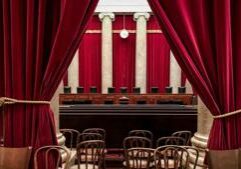
The U.S. Supreme Court heard arguments on Tuesday in a case over a Hawaii law that prohibits concealed carry permit holders from bringing guns on private property that is open to the public.
Wolford v. Lopez challenges a Hawaii law that prevents gun owners from bringing handguns to beaches, bars, restaurants that serve alcohol and gas stations without the owner’s consent. California, Maryland, New Jersey and New York have similar restrictions on guns in public spaces.
“The presumptive ban is inconsistent with our national and historical tradition,” said Alan Beck, a lawyer representing Hawaii gun owners who sued the state.
Beck argued that Hawaii based its law on historical traditions like Black codes which prevented newly formerly enslaved African Americans from obtaining firearms. He said this application is inconsistent with the Second Amendment.
“We can’t use a racist, discriminatory law to apply to a law that applies to the general public,” Beck said.
However, Justice Ketanji Brown Jackson said she did not understand why Black codes should be excluded in the determination of the law if history and tradition are compelling factors.
Neal Katyal, a lawyer representing Hawaii, argued that the purpose of including Black codes in its explanation is to argue evidence that states have historically been allowed to implement gun regulations. He said Hawaii’s law is based on 200 years of customs against carrying weapons.
Justice Neil Gorsuch appeared skeptical about Hawaii’s arguments on the basis of black codes and compared it to “garlic in front of a vampire.”
“You could have rights and regulations that affect someone’s interests but they actually don’t implicate their constitutional rights,” Jackson said, appearing to be in favor of Hawaii’s restrictions.
Similarly, Justice Sonia Sotomayor pressed Beck on whether people are guaranteed a constitutional right to carry guns on private property.
“Nothing about Hawaii’s custom, tradition, or culture creates an expectation that the general public carries guns wherever they go,” Sotomayor said.
Justices also dug into questions over the distinction between guarantees in the First Amendment and the Second Amendment over private property rules. Justices Amy Coney Barrett and Neil Gorsuch questioned lawyers for Hawaii over the difference between bringing a gun to a gas station versus soliciting at someone’s house.
Since the Second Amendment deals with gun possession rather than free speech, “the first amendment rules are different from the second amendment,” Katyal said.
In lower court litigation, Hawaii pointed to a 1771 New Jersey law and 1865 Louisiana law that explicitly required consent before entering a private property of any kind with a gun. Lower courts upheld Hawaii’s arguments on the basis of these laws.
Several justices on the court appeared skeptical of these arguments, and Justice Clarence Thomas said later laws, like the 14th Amendment, should be considered in this case since it was generated in response previous legal restrictions.
“They wanted to disarm the Black population in order to help the [Ku Klux] Klan terrorize them,” Justice Samuel Alito said about Black code laws.
Katyal said Black code laws were a “shameful part of our history” but argued they represent how gun owners did not have the right to carry firearms onto private property.
“Even the opponents of the Black codes recognized that you have no right to carry a firearm onto someone’s property,” Katyal said.
John Commerford, executive director of the NRA-ILA, urged justices on the court to rule against Hawaii’s law.
“The Aloha State’s radical ‘vampire rule,’ which prohibits concealed carry permitholders from entering private property without the express consent of the owner, is a blatant violation of the Second Amendment,” he said.
The “vampire rule” refers to the folklore that vampires need an invitation to enter private property.
The justices will decide whether to uphold Hawaii’s gun restrictions by the end of its term, slated for June or early July.





Chance Showers And Thunderstorms then Showers And Thunderstorms
Latest News Stories
Will County Transportation Department Announces Open House for Manhattan-Monee Road Expansion

Will County Community Mental Health Board Faces $5 Million Shortfall in 2026 Grant Requests

Meeting Summary and Briefs: Public Health & Safety Committee for March 5, 2026

Will County Officials Warn of Zoom Court Scam Targeting Defendants for Fraudulent Dismissal Fees

Will Land Use Committee Evaluates Multi-Million Dollar Buyout for Flooded Harris Drive Homes
Behavioral Health Division Drops Wait Times, Reports Zero Opioid Deaths in February

Meeting Summary and Briefs: Village of Manhattan for March 3, 2026

Harris Drive Residents Plead for County Intervention Amid Failing Septic Systems and Flooding
Manhattan Village Board Approves Public Works Hires and Wastewater Equipment Purchase

Will County Sheriff’s Office Investigates Fatal Hit-and-Run in Homer Glen

Federal Funding Freezes Threaten Will County Public Health Programs Amid Ongoing Lawsuits
Manhattan Village Board Hears Pushback Against Massive Solar Farm and Industrial Expansion